
Which Garage Storage Works Best for Seasonal Items?
Last Updated: October 31, 2026
Quick Summary
The best garage storage for seasonal items matches the storage to how often each item is used. Overhead racks suit bulky, rarely used gear, while shelving and sealed bins keep frequent items reachable. Label everything by season and rotate the bins twice a year.
- Give seasonal items their own zone so the everyday floor stays clear.
- Check the manufacturer’s rated load capacity before buying any overhead rack.
- Mount ceiling racks into joists, not drywall alone.
- Clear plastic bins with sealed lids protect items better than cardboard boxes.
- Rotate and inspect bins at each change of season using a fixed schedule.
Table of Contents
- Why Seasonal Items Need Their Own Storage Plan
- Overhead Garage Storage Options Compared
- Garage Shelving for Storage: Freestanding vs Wall-Mounted
- Seasonal Storage Bins: Plastic, Cardboard and Sealed Totes
- Holiday Decoration Storage and Protecting Items from Moisture and Pests
- Building a Seasonal Inventory, Labels and Rotation Plan
- Choosing the Right Setup for Your Garage and Budget
- Frequently Asked Questions
Every garage collects seasonal belongings: winter tires, holiday decorations, camping gear, garden tools and sweaters that only come out twice a year. Left unplanned, that stuff spreads across the floor and blocks the car. Choosing the right storage for it is less about buying the biggest rack and more about matching the storage to how often each item is used. Seasonal storage is one of the first problems to solve in a garage interior.
Most seasonal items share one trait: they are needed only for a few weeks, then ignored for months. That makes the ideal storage spot the place that is out of the way during the off-season but easy to reach when the season changes. The options below compare overhead racks, shelving, bins and enclosed units so you can see which fits your garage and budget.
Why Seasonal Items Need Their Own Storage Plan
Seasonal items are bulky, infrequently used and awkward to move. A plan that treats them the same as everyday tools usually fails within a year.
A common mistake is storing winter gear in the same place as things you use weekly. The result is a garage where the bin you need in October is buried under the lawn mower. Giving seasonal items their own zone, whether overhead, on high shelves or in a dedicated corner, keeps the everyday floor clear.
Overhead Garage Storage Options Compared
Overhead racks use ceiling space that most garages leave empty. They suit bulky, lightweight items that you rarely reach for, such as camping gear, holiday decor and off-season tires.
The main trade-off is access. Anything stored overhead needs a ladder and a clear path, so keep frequent-use items off the top rack.
Ceiling Racks: Capacity, Mounting and Load Limits
Before buying a ceiling rack, check its rated load capacity and confirm that your ceiling joists can support the mounting hardware. Reported capacities vary widely between products, so compare the manufacturer’s specifications directly rather than relying on a single figure.
Two examples from the market illustrate the range. Other overhead systems are sold on size and layout, and their prices and load ratings should be confirmed with the retailer. In every case, the rating only means something if the ceiling can carry it.
Ceiling Clearance and Installation Checks
Measure the height from the garage floor to the ceiling and to any garage door track or opener before you choose a rack. Leave enough room to walk under the rack and to open the door fully.
Mount racks into framing, not drywall alone. If you are not comfortable finding joists or working overhead, a professional installer can confirm the structure and fit the unit safely. A professional installer can help with this type of installation.
Overhead racks come in several sizes and ratings, so the key specs are worth checking side by side before you buy.
| Check | What to confirm | Note |
|---|---|---|
| Load capacity | Manufacturer’s rated capacity | Ratings vary widely between products |
| Mounting | Attached to ceiling joists | Drywall alone cannot carry the load |
| Ceiling clearance | Height to floor and door track | Leave room to open the door fully |
| Access | Ladder and clear path needed | Keep frequent-use items off the top rack |
Garage Shelving for Storage: Freestanding vs Wall-Mounted
Shelving is the most flexible option. Freestanding units can be moved as your needs change, while wall-mounted systems keep the floor completely open.
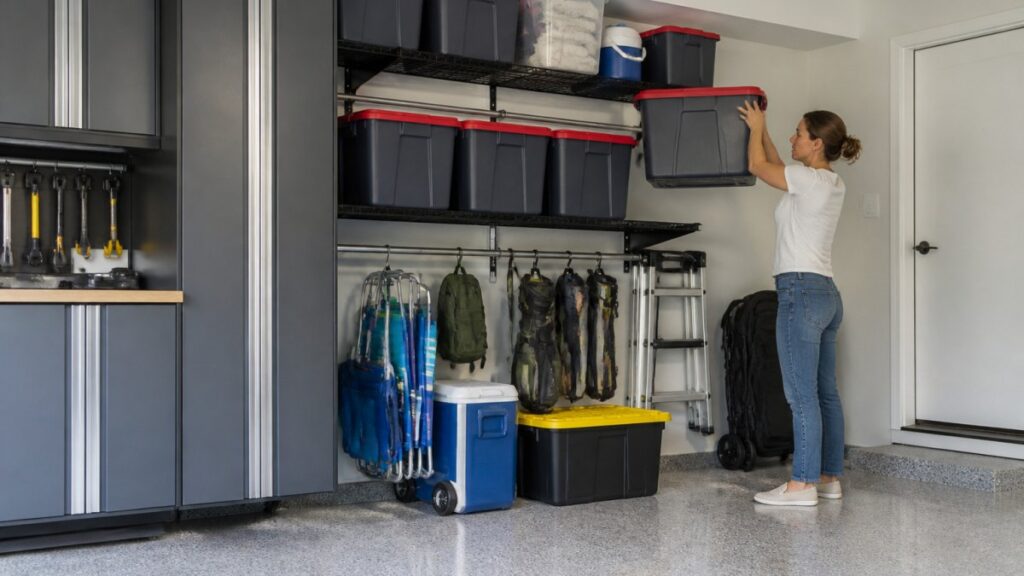
Freestanding shelves work well in older garages where walls are uneven or unfinished. Wall-mounted shelving and slatwall systems are better when floor space is tight, because they keep bins and equipment off the ground. For a wall-based alternative to overhead racks, see garage cabinet layouts with tall towers and upper cabinets. A slatwall system lets you move hooks and shelves as the seasons change, which makes it a strong choice for mixed seasonal gear such as bicycles, golf bags and garden tools. Explore our flexible slatwall storage system to keep those items off the floor.
Check the weight rating on every shelf. Heavy items like tire sets belong on the lowest, strongest shelves, and light items like decorations can go higher.
Seasonal Storage Bins: Plastic, Cardboard and Sealed Totes
The container matters as much as the shelf. Clear plastic bins are the best default. You can see what is inside without opening them, and they resist moisture better than cardboard.
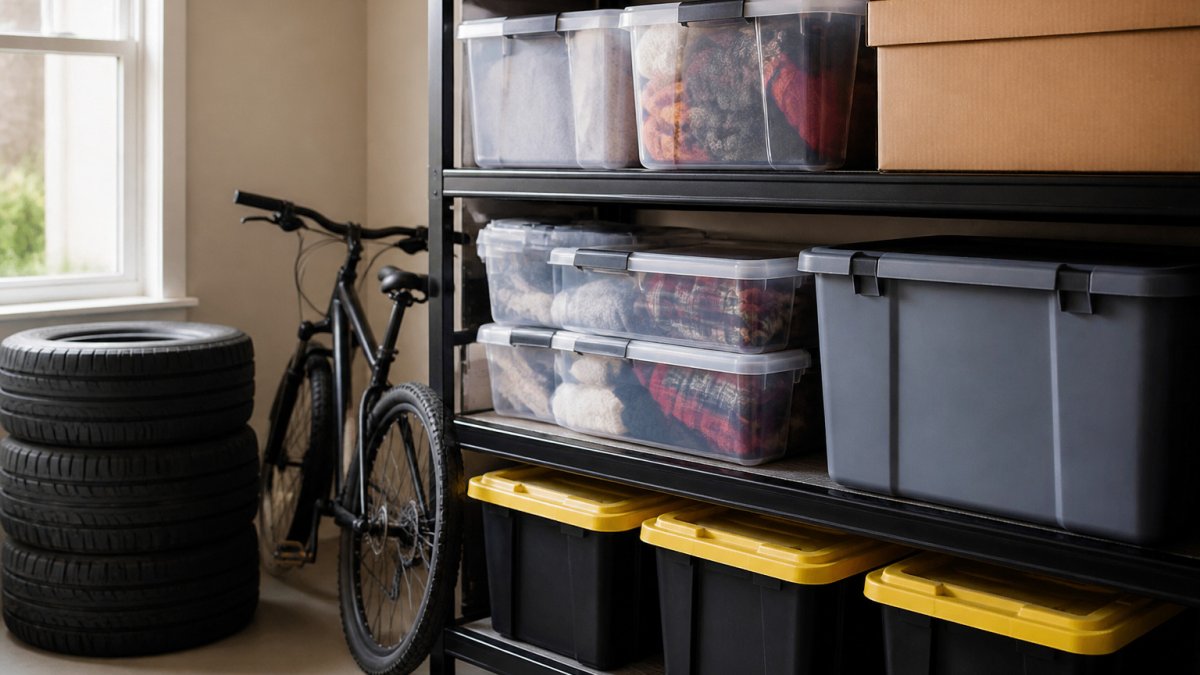
Cardboard boxes are cheap but break down in a damp garage. They also attract pests. If you must use them, keep them off the floor and off exterior walls.
Sealed totes with gasketed lids protect the most valuable items, such as wool sweaters and photo albums, from dust and humidity. Choose opaque bins for items that are damaged by light and clear bins for everything else.
Label every bin with its contents and the season it belongs to. Store the bins you use most often closest to the door.
Schedule Your Private Garage Design Consultation →
Holiday Decoration Storage and Protecting Items from Moisture and Pests
Garages in Canada see large swings in temperature and humidity, and that moisture can ruin fabric, paper and electronics. Keep stored items off the concrete floor, since it can draw damp up into the bottom of boxes. Use a raised shelf or a pallet, and leave a gap along exterior walls where condensation is most likely to form.
Pests find garages attractive for the same reasons people do: warmth, shelter and the chance to nest in cardboard. Seal bins tightly, avoid storing food or pet supplies with decorations, and check stored items once or twice a year. A few cedar blocks or a bag of desiccant inside a tote can help with odour and moisture, though neither replaces a sealed lid.
Breakable decorations should go in padded bins on upper shelves, away from the path of the garage door and the car.
Building a Seasonal Inventory, Labels and Rotation Plan
A storage system works only if you can find things without unpacking five bins. The fix is a simple, repeatable inventory and rotation routine that takes an hour twice a year.
Start with a seasonal inventory
List each seasonal category, where it lives, and when it comes out. A spreadsheet or a notes app works; a printed sheet taped inside a cabinet door works too. For each bin, record:
- Bin ID (a short code such as W-01 for winter, H-03 for holidays)
- Contents summary
- Location (rack, shelf, wall, floor zone)
- Season it is needed
- Any fragile or high-value items
Update the list when you move, replace, or add items. The inventory is only useful if it stays current.
Label so you can read it from the aisle
Label every bin on two adjacent sides with the contents and the season. Use large, high-contrast labels, a label you have to squint at defeats the purpose. Color-code by season if you like: one color for winter, one for summer, one for holidays. Keep a master legend with the inventory so the colors stay meaningful.
Group bins by season rather than by type. A “winter” zone can hold tires, a shovel, and the ice scraper, so everything needed in January is in one place. Within a season, put the most-used bins closest to the door and the heaviest bins on the lowest, strongest shelves.
Rotate on a fixed schedule
Rotate the system twice a year, at the change of season. A simple changeover checklist:
- Bring the outgoing season’s bins to the front and unpack what you need.
- Inspect each item for damage, moisture, or pests before repacking.
- Repack, relabel if contents changed, and return the bins to their off-season zone.
- Move the incoming season’s bins to the front and confirm they are complete.
- Update the inventory and note anything to replace.
Set a calendar reminder for the change of season so the routine stays consistent. A fixed date, for example, the first weekend of October and the first weekend of April, is easier to remember than “when it gets cold.”
Photograph the inside of each bin before you seal it and keep the photos with the inventory. When a label fades or a bin is repacked, the photo tells you what should be inside.
A rotation plan also surfaces problems early: a damp bin, a cracked tote, or a missing item is easier to fix at the changeover than in the middle of the season when you need it.
Choosing the Right Setup for Your Garage and Budget
The best setup depends on your ceiling height, floor space, the items you store and your budget. A small garage with a standard ceiling may need wall-mounted shelving and bins. A larger garage with high ceilings can use overhead racks for the bulkiest items. Many homeowners combine both.
Begin with the items you store most, measure the space available, then choose the storage type that fits. Compare load ratings, installation requirements and prices before you buy, and confirm current prices with each retailer, since they change frequently.
If you want a garage that stores seasonal gear cleanly and looks finished, Lux Garages can design the garage as one project. Browse our garage storage and cabinet options to see what a planned layout can include, or view our completed garage design projects for finished examples.
Frequently Asked Questions
What is the best way to store seasonal items in a garage?
Group items by season, store the ones you use least at the highest or back positions, and keep frequently used seasonal gear closest to the door. Use sealed bins or a closed cabinet for anything sensitive to moisture, and label every container with its contents and season. Start by clearing the floor, since keeping seasonal belongings off it frees space for parking and workbench use. Check each setup once a year to remove items you no longer need.
Are plastic bins or cardboard boxes better for garage storage?
Sealed plastic bins are usually the better choice for a garage. Cardboard absorbs moisture, attracts pests and weakens when temperatures swing, which is common through the winter. Clear, lidded plastic totes protect contents from dust and moisture and let you see what is inside without unpacking. Reserve cardboard for short-term use indoors or for items that need breathability, such as some fabrics.
How do you protect seasonal items from moisture and temperature changes in a garage?
Keep stored items off the concrete floor on shelves, since slab moisture can seep into boxes. Use sealed bins with tight lids and add silica gel packs to contain humidity. Avoid storing items that are sensitive to cold, such as some electronics or paint, in unheated areas. Check the garage for leaks or condensation at least twice a year and fix any moisture sources before storing belongings there.
How should you organize holiday decorations in a garage?
Sort decorations by room or theme, pack fragile pieces separately with padding, and store each category in its own labelled bin. Place the bins you open only once a year on higher or overhead shelving, and keep decorations you use often in front. Keep a simple inventory list on the lid or in a notebook so you know what is stored where before the next season starts.
Ready to stop tripping over the winter tires? Schedule Your Private Garage Design Consultation with Lux Garages to plan storage that suits how you use your garage.
