Slatwall vs Pegboard for Garage Storage
Table of Contents
- Slatwall vs Pegboard: The Core Differences
- Garage Slatwall Panels: Strength and Durability
- Garage Pegboard Tool Storage: Versatility and Cost
- Slatwall Weight Capacity and Load-Bearing Performance
- Installation, Flexibility, and Long-Term Value
- French Cleat Wall Storage: An Alternative Approach
- Which System Should You Choose?
- Frequently Asked Questions
Last Updated: October 10, 2026
Slatwall vs Pegboard: The Core Differences
Choosing between slatwall and pegboard shapes how you’ll organize tools and equipment. Both mount to walls and accept hooks, but differ significantly in durability, weight capacity, and flexibility.
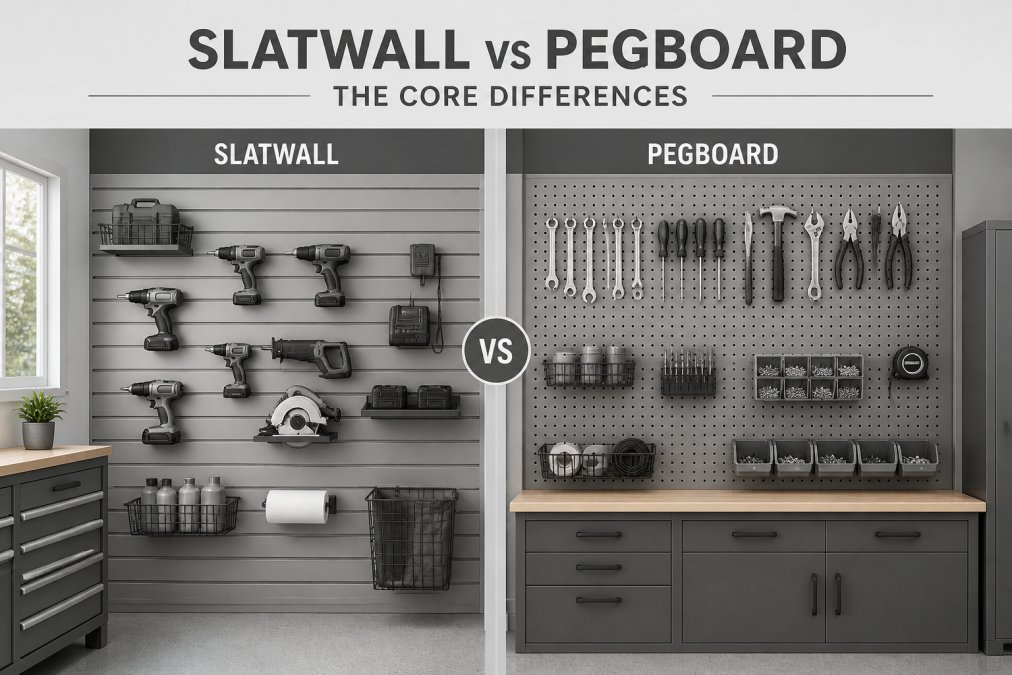
Slatwall features horizontal slats spaced evenly across a panel, typically made from medium-density fiberboard (MDF), PVC, or aluminum. Pegboard uses a grid of small holes punched throughout a sheet, usually made from hardboard or MDF.
The core distinction: slatwall prioritizes strength and durability for heavy tools, while pegboard emphasizes affordability and versatility for lighter storage. Neither is universally superior; each excels in different contexts.
Garage Slatwall Panels: Strength and Durability
Slatwall panels distribute weight across the entire surface, supporting substantially more weight than pegboard. Properly mounted to wall studs, it becomes a semi-permanent, durable storage solution.
Slatwall resists warping, moisture damage, and impact far better than pegboard.
Installation demands precision: fasten directly to wall studs with bolts or heavy-duty screws spaced every 16 inches vertically. Improper installation compromises weight capacity.
Accessory compatibility matters long-term. Slatwall hooks, brackets, and bins are standardized across manufacturers, but not universally interchangeable with pegboard accessories. Once you commit to slatwall, you’re investing in a system where future additions will be slatwall-specific.
Garage Pegboard Tool Storage: Versatility and Cost
Pegboard offers simplicity and affordability.
Initial cost is significantly lower than slatwall. Pegboard panels, hooks, and brackets are inexpensive and widely available.
The trade-off is weight capacity and durability. Pegboard handles light to medium tools well but stresses under heavy power tools.
Installation is straightforward: mount to studs or drywall with appropriate anchors. However, improper installation without adequate support leads to sagging and premature failure.
Pegboard hooks are inexpensive but quality varies widely. Premium accessories approach slatwall pricing, eroding the cost advantage over time.
Slatwall Weight Capacity and Load-Bearing Performance
Weight capacity is where slatwall’s engineering advantage becomes concrete. Capacity ratings depend on panel material, fastening method, stud spacing, and hook design.
How Weight Capacity Is Determined
Weight capacity ratings reflect the maximum load a properly installed panel can support per linear foot of wall space. The rating assumes:
- Fastening to solid wood studs spaced 16 inches on centre
- Fasteners penetrating at least 1.5 inches into stud material
- Weight distributed across multiple hooks rather than concentrated at a single point
- Hooks and brackets rated for the same load as the panel
If any of these conditions are not met, actual capacity is lower than the published rating.
Slatwall Capacity by Material
MDF Slatwall: 50-75 pounds per linear foot. Denser than pegboard but less durable than PVC or aluminum in humid environments. Requires heavy-duty bolts or 3-inch screws spaced 16 inches vertically. A 4-foot section safely supports 200-300 pounds. Lifespan: 10-15 years in dry garages; 5-10 years in humid environments.
PVC Slatwall:
- Typical rating: 75-100 pounds per linear foot
- Material strength: PVC is more moisture-resistant than MDF and resists warping and rot. It’s lighter than aluminum but heavier than MDF.
- Fastener requirement: Heavy-duty bolts or 3-inch wood screws, spaced 16 inches vertically. PVC panels are thicker and require longer fasteners than MDF.
- Real-world example: A 4-foot-wide PVC slatwall section can safely support 300-400 pounds. This capacity accommodates heavy power tools, compressors, and specialized equipment without concern.
- Lifespan: 15-20 years in most garage environments, including humid basements and uninsulated spaces
Aluminum Slatwall: 100-150+ pounds per linear foot. Strongest and most durable; resists moisture, temperature swings, and impact without warping or rot. Requires heavy-duty bolts or stainless steel fasteners spaced 16 inches vertically. A 4-foot section safely supports 400-600 pounds. Lifespan: 20+ years.
Individual Hook and Bracket Ratings
Panel capacity is only one half of the equation. Each hook and bracket also has a weight rating, typically 10-50 pounds depending on design and material. A hook rated for 15 pounds cannot safely hold a 30-pound tool, even if the panel itself is rated for 100+ pounds per linear foot.
When selecting hooks and brackets:
- Match hook rating to tool weight. A 25-pound impact driver requires a hook rated for at least 25-30 pounds.
- Use multiple hooks for heavy items. A 40-pound compressor should be supported by two hooks rated for 25+ pounds each, distributing the load.
- Check fastener compatibility. Hooks must be compatible with slatwall slot spacing (typically 3/4 inch or 1 inch). Mismatched hooks may slip or fail.
- Inspect hooks regularly. Over time, hooks can bend, crack, or loosen. Replace damaged hooks immediately.
Pegboard Capacity by Material and Installation
Hardboard Pegboard (mounted to studs): 15-25 pounds per linear foot. Flexes under load, stressing fastening points and enlarging holes. Requires bolts or screws spaced 16 inches to studs; drywall anchors alone are insufficient. A 4-foot section safely supports 60-100 pounds. Lifespan: 5-10 years in dry garages; 3-5 years in humid environments.
Pegboard mounted to drywall: 5-10 pounds per linear foot. Drywall anchors cannot support the same load as stud fastening. A 4-foot section safely supports only 20-40 pounds total. Lifespan: 2-5 years; this is a temporary solution.
Impact of Stud Spacing and Backing
Stud spacing directly affects capacity. Standard framing places studs 16 inches on centre (Proposed Change 1677). If your garage has non-standard framing (24 inches on centre or wider), capacity is reduced by approximately 25-33%. If studs are not available at your desired location, horizontal backing boards (2×4 lumber) must be installed between studs to create a fastening surface. Backing boards reduce effective capacity slightly but restore the ability to mount panels where studs are absent.
Real-World Load Examples
Heavy workshop scenario:
- Impact driver (20 lbs)
- Orbital sander (25 lbs)
- Drill press (35 lbs)
- Compressor (40 lbs)
- Miscellaneous hand tools and accessories (30 lbs)
- Total: 150 lbs in one 4-foot section
Slatwall (MDF or PVC): Easily accommodates this load across 5-6 hooks rated for 25+ pounds each. Capacity is not a concern.
Pegboard: This load exceeds safe capacity. The pegboard will flex, holes will enlarge, and hooks will slip. Distributing the load across two pegboard sections (8 feet total) brings it within safe limits, but the system will show wear within 2-3 years.
Schedule Your Private Garage Design Consultation →
Light workshop scenario:
- Hand drill (8 lbs)
- Screwdriver set (3 lbs)
- Hammer and mallets (10 lbs)
- Measuring tools (5 lbs)
- Miscellaneous small tools (15 lbs)
- Total: 41 lbs in one 4-foot section
Both slatwall and pegboard handle this load comfortably. Pegboard’s lower capacity is not a limiting factor. Cost and ease of installation become the deciding factors.
Verifying Capacity for Specific Products
Manufacturer specifications vary. Before purchasing, verify:
- Panel weight rating (pounds per linear foot)
- Individual hook or bracket rating (pounds per hook)
- Fastener requirements (bolt size, spacing, stud penetration)
- Backing and spacing requirements (air gap, horizontal support)
- Warranty and lifespan claims
Reputable manufacturers (such as those producing commercial-grade slatwall) publish detailed specification sheets. If a product does not provide clear capacity ratings, it is likely not engineered for heavy use. Avoid products with vague claims like “heavy-duty” or “industrial-strength” without numerical backing.
Installation, Flexibility, and Long-Term Value
Installation difficulty and long-term flexibility often determine which system truly serves you best. Understanding the practical requirements of each approach, and calculating true cost of ownership, reveals why slatwall’s higher upfront expense often delivers better value over time.
Slatwall Installation: Precision and Permanence
Locate wall studs with a stud finder and fasten the panel securely every 16 inches vertically. Fasteners must penetrate 1.5+ inches into solid wood; drywall anchors alone will fail. Use a spirit level to ensure the panel is plumb. If studs are unavailable, install horizontal backing boards (2×4 lumber). Once installed, slatwall is semi-permanent. Installation takes 2-4 hours for a 4×8 panel. Professional installation ($200-$500) is worth the investment if you’re uncertain about stud location or fastening techniques.
Pegboard Installation: Speed and Reversibility
Mount pegboard to studs or drywall with heavy-duty anchors rated for 50+ pounds, spaced every 16 inches. Use spacers (1/4-inch strips) between panel and studs to reduce moisture trapping. Installation takes 1-2 hours for a 4×8 panel. This reversibility suits renters and those who experiment with layouts, but improper fastening causes sagging and warping.
Total Cost of Ownership: The Long-Term Picture
Initial panel cost is only one component of true cost of ownership. A complete comparison includes panels, fasteners, trim, accessories, and replacement cycles.
Slatwall (4×8 MDF panel): $470-$1,090 initial investment; 15-20 year lifespan; $24-$73 per year. With one accessory refresh every 7-10 years, cost rises to $38-$93 per year over 20 years.
Pegboard (4×8 hardboard panel): $185-$440 initial investment; 5-10 year lifespan. Requires replacement every 7 years; three cycles over 20 years cost $555-$1,320 total, or $28-$66 per year. When factoring in replacement cycles, cost-per-year advantage narrows significantly.
Reconfiguration and Flexibility
Reconfiguration is easier with pegboard; moving a hook takes seconds. Slatwall’s fixed slot spacing (3/4 or 1 inch) limits hook placement but is fine enough for most arrangements. If you frequently reorganize, pegboard’s flexibility has real value. If you settle on a layout and stick with it, slatwall’s permanence is an advantage.
Hybrid Approach: Combining Systems
Many garages benefit from a hybrid strategy. Install slatwall in high-traffic areas where you store heavy tools and equipment, and pegboard in secondary areas for light accessories, seasonal items, or experimental storage. This approach leverages each system’s strengths while managing overall cost. A hybrid installation typically costs 20-30% more than a single-system approach but offers superior flexibility and durability across the entire garage.
French Cleat Wall Storage: An Alternative Approach
French cleat wall storage deserves consideration alongside slatwall and pegboard.
French cleats excel for custom cabinetry and shelving. They’re ideal if you want a cohesive, finished appearance rather than visible hooks and accessories.
The trade-off: French cleat systems are custom-built, not modular. You can’t easily rearrange once installed.
French cleats pair well with slatwall or pegboard. Many garages combine approaches, French cleats for heavy storage cabinets, slatwall for tool organization, pegboard for lighter accessories. This hybrid strategy leverages each system’s strengths.
Which System Should You Choose?
The right choice depends on three factors: the tools you’re storing, your garage environment, and your budget.
Choose slatwall if:
- You own heavy power tools, compressors, or specialized equipment
- Your garage experiences humidity, temperature swings, or moisture exposure
- You plan to keep the system in place for 10+ years
- You want a professional, finished appearance
- You’re willing to invest more upfront for durability
Choose pegboard if:
- You store primarily hand tools and light accessories
- You rent your home or move frequently
- You enjoy experimenting with storage layouts
- Your budget is tight and you’re willing to replace or upgrade in 5-10 years
- You value quick, simple installation
Consider a hybrid approach if:
- You have both heavy and light tools to store
- You want flexibility in some areas and permanence in others
- You’re designing a comprehensive garage renovation
The decision between slatwall and pegboard isn’t about finding the objectively “best” option; it’s about matching the system to your actual needs, environment, and timeline. Assess your tool collection, consider your garage’s moisture and temperature patterns, and think honestly about how often you’ll reconfigure. That clarity makes the choice straightforward.
Frequently Asked Questions
Can slatwall hold heavier tools than pegboard?
Yes. Slatwall typically supports 45-55 kg per hook when properly installed into wall studs, while standard pegboard handles 9-14 kg per hook. Slatwall’s solid construction and deeper hook engagement distribute weight more effectively. For power tools, impact wrenches, and heavy hand tools, slatwall is the stronger choice. Pegboard works for lighter items like screwdrivers, wrenches, and small power tools.
Which is easier to rearrange: slatwall or pegboard?
Pegboard offers faster rearrangement because hooks simply slide into existing holes without tools. Slatwall requires removing brackets and drilling new holes, which takes more time. If you frequently reorganize your garage layout or experiment with different storage configurations, pegboard’s flexibility wins. Slatwall excels when you’ve settled on a final layout and want stability.
Is pegboard or slatwall better for a garage workshop?
It depends on your tool collection and budget. Slatwall suits workshops storing heavy power tools, impact drivers, and specialty equipment because of superior weight capacity and durability. Pegboard works well for hand tools, small accessories, and lighter equipment while keeping costs lower. Many professional workshops use slatwall; many hobbyist garages use pegboard successfully. Consider what you’re actually storing before deciding.
What’s the total cost of ownership difference between slatwall and pegboard?
Pegboard has lower upfront costs but may need replacement every 5-10 years due to warping or damage, especially in humid garages. Slatwall costs more initially but lasts 15-20+ years with minimal maintenance. Over 20 years, replacing pegboard twice could approach slatwall’s total investment. Factor in your garage’s moisture levels and climate when calculating long-term value.
Schedule your private garage design consultation with Lux Garages. Our team will assess your space, discuss your storage needs, and recommend a system tailored to your lifestyle, whether that’s professional-grade slatwall, flexible pegboard, or a custom combination that maximizes both organization and aesthetic appeal. Learn more about garage storage solutions from industry experts