Professional Garage Storage System Benefits
Table of Contents
- Why a Professional Garage Storage System Beats Off-the-Shelf Solutions
- Garage Storage Buying Guide: Types of Systems and What to Look For
- Garage Cabinets vs. Open Shelving: Which Fits Your Space?
- Overhead Garage Storage: How to Reclaim Floor Space Safely
- Garage Tool Storage Ideas That Keep Your Workspace Functional
- Planning by Household Needs and Garage Dimensions
- The Real Payoff: Property Value, Durability, and Long-Term Savings
- Conclusion: Making the Right Choice for Your Garage
- Frequently Asked Questions
Last Updated: October 12, 2026
Why a Professional Garage Storage System Beats Off-the-Shelf Solutions
A professional garage storage system is a custom-designed, professionally installed combination of cabinets, shelving, wall panels, and overhead racks engineered to fit your specific garage dimensions and load requirements.
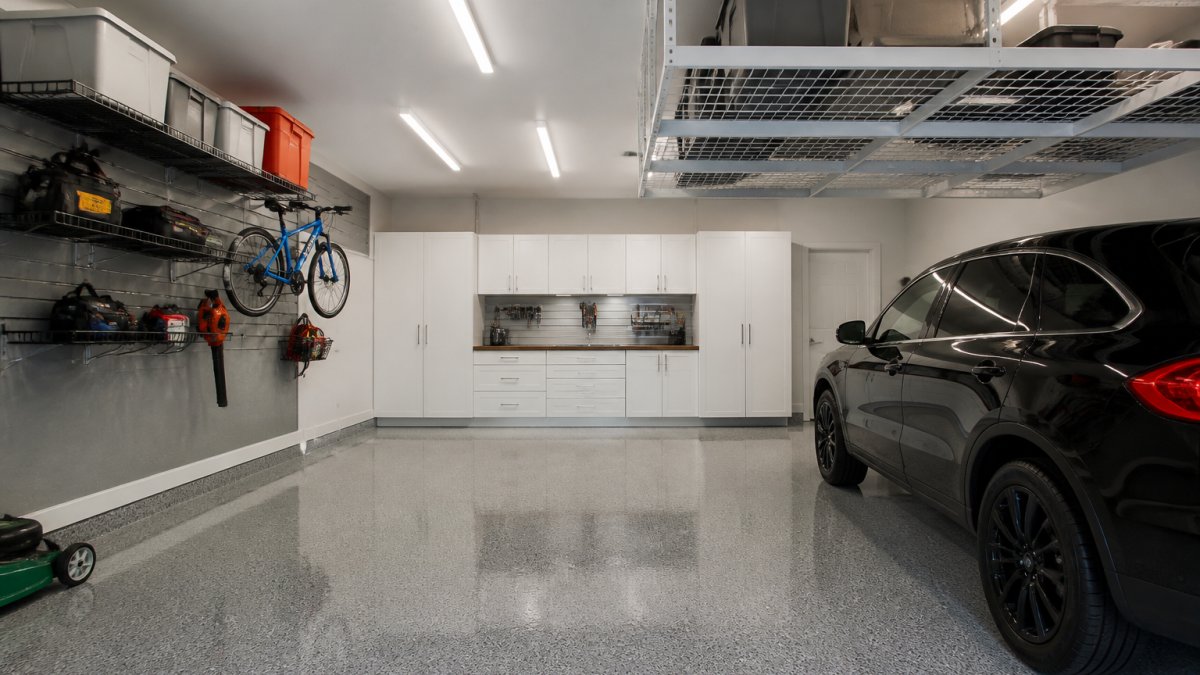
Off-the-shelf shelving units are rated for light residential loads and rarely account for a garage’s concrete slab, wall stud spacing, or freeze-thaw movement.
Here’s what most buying guides get wrong: they treat storage as a shopping problem. It’s a planning problem first. Get the layout and load plan right, and the products almost choose themselves.
The single biggest upgrade isn’t more shelves. It’s moving storage off the floor and onto anchored wall and ceiling systems, which frees the space you actually walk and park in.
Garage Storage Buying Guide: Types of Systems and What to Look For
Any solid garage storage buying guide starts with the four system families, because each solves a different problem.
| System Type | Best For | Load Reality | Main Trade-Off |
|---|---|---|---|
| Garage cabinets | Concealing clutter, tools, chemicals | High, when anchored | Higher cost per unit |
| Open shelving | Fast access, low budget | Moderate | Visible dust and clutter |
| Wall-mounted panels and rails | Tools, brooms, small items | Light to moderate | Needs stud or masonry anchoring |
| Overhead and ceiling racks | Seasonal and bulky items | Moderate to high | Requires correct ceiling structure |
When you’re evaluating any option, check four things before price: the stated weight capacity, the anchoring method, the material (powder-coated steel and marine-grade laminate hold up better than particleboard in a garage’s humidity swings), and whether the system is adjustable. Adjustable shelving matters more than most people expect, because your storage needs change when a hobby does.
Garage Cabinets vs. Open Shelving: Which Fits Your Space?
The garage cabinets vs. open shelving decision comes down to what you’re storing, how much you care about appearance, and how much load the wall behind it can actually take.
Enclosed cabinets suit paint, chemicals, sporting goods, and anything you’d rather not see. Lockable cabinets add a layer of safety for households with young children or for valuable items.
Open shelving is faster to access and cheaper to install. The drawback is that it exposes contents to dust and makes a garage look busier.
What the comparison misses: load ratings and anchoring
Most buying guides stop at aesthetics. The real differentiator is what the wall can carry and how the unit is fastened to it.
- Wall cabinets are typically rated in the range of 45-90 kg (100-200 lb) per cabinet when fastened into studs or a properly engineered rail system. A cabinet hung on drywall anchors alone will fail long before it reaches that rating.
- Base cabinets carry more because the load transfers to the floor and the cabinet box, not the fasteners. This is why heavy items like tool chests, paint cans, and dense storage bins belong low.
- Open shelving ratings vary widely. Light-duty wire or particleboard units may hold 20-30 kg (45-65 lb) per shelf; heavier steel or laminate shelving anchored into studs can hold considerably more. The shelf rating is only valid if the bracket is anchored correctly.
- Wall panels and rails distribute load across multiple fastening points, which is why they handle tools and small items well but should not be used for tires or engine parts.
Anchoring: the part that decides whether the rating is real
A stated weight capacity assumes the unit is attached to structure. In a typical garage, that means:
- Locating wall studs (commonly spaced 400 mm or 600 mm on center, depending on how the home was framed) and fastening into them, or into a horizontal rail that spans multiple studs.
- For masonry or concrete walls, using appropriate masonry anchors rather than standard screws.
- For overhead or ceiling-mounted units, confirming joist direction and spacing before drilling, and never relying on drywall alone.
If you are unsure what is behind the wall, a stud finder and a quick check of the framing is worth more than any upgrade to the cabinet itself.
A practical way to choose
- List what you are storing and estimate the weight of the heaviest single item and the heaviest shelf or cabinet load.
- Match that weight to a system whose rating exceeds it with margin, not one that just meets it.
- Confirm the anchoring method suits your wall type.
- Only then compare finishes, door styles, and price.
If you cannot identify the studs or the ceiling structure, that is the moment to bring in a professional. The cost of a failed cabinet or rack is far higher than the cost of getting the anchoring right the first time.
Overhead Garage Storage: How to Reclaim Floor Space Safely
Overhead garage storage is the fastest way to reclaim floor space, but it’s also where safety mistakes happen most. A ceiling rack is only as strong as what it’s attached to.
Before installing anything overhead, confirm what the ceiling structure can carry. Racks should be fastened into joists or a properly engineered mounting system, not drywall alone. Load ratings matter: a rack rated for light bins should never hold tires or engine parts. Keep heavy items low and light, seasonal items high.
- Store seasonal items, empty coolers, and light bins overhead
- Keep tires, tool chests, and dense boxes at floor or cabinet level
- Leave clearance for your vehicle’s roof and for the garage door’s travel path
- Re-check fasteners annually, since vibration loosens hardware over time
Hanging a heavy rack from drywall anchors instead of structural framing is the most common overhead storage failure. The rack can pull free under load, and whatever is above your car comes down with it.
Garage Tool Storage Ideas That Keep Your Workspace Functional
Good garage tool storage ideas share one principle: the tools you use most should be within arm’s reach of the workbench, and everything else should be out of the way.
Wall-mounted rails and panels keep hand tools visible and off the bench. A pegboard or slatwall section above the workbench handles screwdrivers, wrenches, and clamps.
The real test of a tool layout is whether you can start a project without clearing space first. If you can’t, the storage is working against you.
Planning by Household Needs and Garage Dimensions
Start with a measured plan, not a shopping list. Most garages fall into a few common sizes, and the layout that works for a single-car space rarely fits a double.
Schedule Your Private Garage Design Consultation →
- Single-car garage: prioritize vertical storage and overhead racks; floor space is too precious for freestanding units.
- Double-car garage: dedicate one wall to cabinets and one to a workbench, keeping the center clear for vehicles.
- Three-car or oversized: zone the space, with a workshop area, a parking area, and a storage wall.
Then map your household’s actual contents: vehicles, bikes, sports equipment, seasonal items, tools, and garden gear. Measure the largest items first, because they dictate the layout. A system designed around a canoe and two bikes looks nothing like one designed around a sedan and a toolbox.
Measure your garage door’s clearance and its travel path before planning overhead storage. Racks placed in the door’s swing zone get struck every time the door opens, which damages both.
The Real Payoff: Property Value, Durability, and Long-Term Savings
Most articles on this topic end with a vague claim that a nice garage is “worth it.” That is not useful. The honest version is a total cost of ownership comparison: what you pay up front, what you pay over time, and what you get back.
The cost structure of a professional system
A professionally designed and installed garage storage system typically has four cost components:
- Design and layout, measuring the space, planning zones, and specifying products. Often bundled into the installation quote.
- Materials and components, cabinets, shelving, rails, overhead racks, and hardware. This is the largest line item and scales with the size and finish level of the system.
- Installation labor, anchoring, leveling, and fitting. This is where the difference between a system that lasts and one that does not is decided.
- Optional upgrades, lighting, flooring, electrical, and lockable storage.
A DIY or big-box alternative shifts cost from installation to your own time and risk. That trade can make sense for light shelving in a single-car garage. It rarely makes sense for overhead racks, heavy cabinets, or anything that has to hold significant weight above a vehicle.
Durability: where the long-term math actually lives
Cheap shelving that sags, rusts, or pulls out of the wall gets replaced, sometimes more than once over the life of a home. Professionally installed systems with powder-coated steel, proper anchoring, and quality hardware are built to outlast the house’s next owner.
A few practical durability factors to weigh:
- Moisture and temperature swings. Garages are unconditioned in most homes. Powder-coated steel and marine-grade laminate resist humidity and freeze-thaw cycles far better than particleboard, which swells and loses strength once it takes on water.
- Corrosion. In coastal or heavily salted-road regions, hardware and fasteners matter as much as the cabinet finish. Stainless or coated fasteners last longer.
- Wear points. Door hinges, drawer slides, and shelf brackets are the first things to fail. Quality hardware is the difference between a system that still works in 15 years and one that needs replacing in five.
- Service life. A well-anchored steel or high-grade laminate system, maintained reasonably, is commonly expected to serve for the life of the home’s ownership.
Maintenance: what is actually required
Maintenance is minimal, but it is not zero:
- Wipe down surfaces periodically to remove dust and grit.
- Check fasteners and anchoring annually, since vibration and seasonal movement can loosen hardware.
- Keep the floor clear of standing water, which is the single biggest threat to cabinet bases and flooring.
- Re-tighten or replace any hardware that shows play before it becomes a failure.
The resale angle, stated honestly
A finished, organized garage reads as usable square footage to a buyer, and that perception carries weight at resale. Real estate professionals consistently note that well-presented, functional spaces help homes show better, and a garage is one of the first things buyers inspect. What that translates to in dollars varies by market, home, and buyer, no responsible source will promise a fixed return.
The total cost of ownership argument is not “storage pays for itself.” It is that a properly anchored, moisture-resistant system is replaced less often, needs less repair, and removes a buyer objection, three concrete savings that a cheap system does not deliver.
guidance on anchoring and load ratings for residential storage
Conclusion: Making the Right Choice for Your Garage
The hardest part of a garage project isn’t picking cabinets. It’s designing a layout that fits your vehicles, your tools, and how you actually use the space, then installing it so it stays safe under load for years.
At Lux Garages, we handle the full scope: custom cabinetry, professional-grade epoxy and polyaspartic flooring, high-efficiency lighting, and structural planning that accounts for your garage’s actual dimensions and load requirements.
Schedule your private garage design consultation and get a layout built around your space, not a shelf kit’s.
Frequently Asked Questions
What are the benefits of a professional garage storage system?
A professional garage storage system improves organization, protects vehicles and equipment, and increases property value. Custom cabinets and overhead storage reduce clutter, while durable materials like epoxy flooring resist wear. Many homeowners find that a well-designed system makes the garage a functional extension of the home, whether for parking, hobbies, or storage.
Is professional garage organization worth the cost?
It depends on your goals and budget. Professional systems cost more upfront than off-the-shelf options, but they last longer and can add resale value. If you plan to stay in your home or have valuable vehicles and tools, the investment often pays off through better protection and reduced replacement costs. Request a quote to see what fits your situation.
Are garage cabinets better than open shelving?
Cabinets offer dust protection, concealment, and security for valuable items, while open shelving provides easy access and ventilation. For a clean look and protection, cabinets are ideal. For frequently used tools or bulky items, open shelving works well. Many homeowners combine both: cabinets for clutter and shelving for accessibility.
How can overhead garage storage help save floor space?
Overhead garage storage uses ceiling space to store seasonal items, sports equipment, and bins, freeing up floor area for vehicles or a workbench. Proper anchoring and load ratings are critical for safety. A professional installer can ensure the structure supports the weight and that items remain accessible without obstructing daily use.