Garage Floor Tiles vs Polished Concrete: 2026 Comparison
Table of Contents
- Garage Floor Tiles vs Polished Concrete: Which Works Best for Home Use
- Garage Floor Tiles: Pros and Cons
- Polished Concrete Garage Floor: Pros and Cons
- Interlocking Garage Floor Tiles: Types and Performance
- Garage Flooring Cost Comparison: Tiles vs Polished Concrete
- Durability and Resistance: Vehicle Weight, Hot Tires, and Spills
- Maintenance and Cleaning: Long-Term Effort and Costs
- Installation, Disruption, and Timeline
- Frequently Asked Questions
Last Updated: October 17, 2026
Garage Floor Tiles vs Polished Concrete: Which Works Best for Home Use
Choosing between garage floor tiles and polished concrete is one of the biggest decisions in a garage renovation. Both transform a bare slab into a functional surface, but they differ sharply in performance, maintenance, and long-term cost.
It isn’t about which option is universally “better,” but which fits how you use your garage, your maintenance tolerance, and your budget over the next decade.
This guide breaks down garage floor tiles vs polished concrete side by side: durability under vehicle weight and hot tires, maintenance, lifecycle costs, and installation disruption.
Garage Floor Tiles: Pros and Cons
Advantages of Modular Tiles
Modular garage floor tiles offer flexibility polished concrete cannot match: self-installation, section-by-section replacement, and customizable appearance.
The biggest advantage is damage containment. A cracked or stained tile pops out and is replaced in minutes, while polished concrete damage requires professional repair or resurfacing. That modularity suits garages whose purpose may still change.
Tiles also handle moisture well, shedding water and resisting salt staining that shows on polished concrete, a real benefit where winter road salt gets tracked in.
Installation is straightforward: most tiles interlock without adhesive, so you can finish in a weekend with no curing time, no chemical odors, and minimal disruption.
Disadvantages of Modular Tiles
The trade-off is durability under sustained pressure. Tiles flex slightly under heavy vehicle weight, and over years seams can separate or tiles shift. On an uneven slab, tiles mirror the imperfections and create trip hazards.
Seams are a maintenance headache: dirt, oil, and moisture accumulate in the gaps, cleaning takes more effort than a seamless surface, and seams can harbor mold without proper ventilation.
Cost per square foot is often higher than polished concrete, though installed price depends on tile quality and slab condition. Budget for slab prep if your concrete is badly cracked or uneven.
Polished Concrete Garage Floor: Pros and Cons
Advantages of Polished Concrete
Polished concrete creates a seamless, professional surface that feels permanent and refined, one continuous floor with no seams to collect debris and no tiles to shift.
Done properly, polished concrete is remarkably durable. It resists vehicle weight, hot tires, and oil spills better than most homeowners expect, because polishing hardens the surface into a protective layer that sheds stains and moisture more effectively than raw concrete.
Aesthetically, polished concrete offers a sophisticated, showroom-quality look, and the reflective finish makes the space feel larger and brighter. Decorative scoring, color additives, or aggregate exposure add customization at extra cost and complexity.
Maintenance is simpler in theory: no seams to clean or tile edges to trap dirt, so sweeping and occasional mopping usually suffice.
Disadvantages of Polished Concrete
The biggest disadvantage is permanence in the wrong direction. Once damaged, repair is expensive and visible: a deep scratch, spall, or chemical stain requires professional grinding and repolishing a section or the entire floor.
Polished concrete is also slippery when wet, a genuine safety concern in socks or wet shoes. Anti-slip coatings help but add cost and can dull the finish.
Environmental factors matter more with polished concrete.
Installation requires professional expertise and typically takes 3-7 days depending on slab condition and finish, during which the garage is inaccessible; curing means you can’t use the space immediately afterward.
Interlocking Garage Floor Tiles: Types and Performance
Not all garage floor tiles are equal. Knowing the main types helps you choose the right system.
Solid vinyl tiles are rigid, thick, and built to withstand vehicle weight without flexing. They cost more than thinner alternatives but perform better under sustained pressure.
Polypropylene tiles are lighter, more flexible, and budget-friendly, but they flex under vehicle weight and can separate at seams over time. Best for light-duty or temporary use.
Composite tiles combine materials for balanced performance: moderate durability, good moisture resistance, and a professional look, a middle ground between budget vinyl and premium solid tiles.
Seam type matters too. Raised edges trap debris; beveled or flush edges minimize seam visibility, and tongue-and-groove interlocks are more stable than tiles that simply butt together.
Garage Flooring Cost Comparison: Tiles vs Polished Concrete
Cost often decides it, but comparing garage floor tiles vs polished concrete requires looking beyond the initial price tag, a 10-year ownership model with transparent assumptions, not a single installed price.
Upfront cost ranges (CAD, 2026)
For a typical 500-square-foot residential garage, expect the following installed cost ranges. These are planning ranges, not quotes; local labor rates, slab condition, and finish level move the number substantially.
| Cost item | Modular garage tiles | Polished concrete |
|---|---|---|
| Material | $3.50-$8.00/sq ft | $0.50-$1.50/sq ft (densifier, sealer, guards) |
| Labor | $0-$2.50/sq ft (DIY possible) | $4.00-$9.00/sq ft |
| Slab prep | $0-$2.00/sq ft | $1.00-$4.00/sq ft |
| Typical installed total | $3.50-$10.50/sq ft | $5.50-$14.50/sq ft |
| 500 sq ft project total | $1,750-$5,250 | $2,750-$7,250 |
Tiles can undercut polished concrete on total installed cost when you self-install a mid-grade interlocking system on a sound slab. Polished concrete wins on material cost but loses on labor, because grinding, densifying, polishing, and sealing are specialist work.
Schedule Your Private Garage Design Consultation →
Lifecycle cost assumptions
A fair 10-year model uses these assumptions:
- Service life: quality interlocking tiles 10-20 years; polished concrete 15-25 years with maintenance.
- Resealing: polished concrete every 2-3 years.
- Repairs: tile replacement is for DIY; polished concrete spot repair requires grinding and re-polishing a section.
- Cleaning supplies: for either surface.
- Replacement: full tile replacement at year 15-20; polished concrete re-polish at year 10-15.
Run those assumptions and the 10-year totals converge. The gap narrows because polished concrete’s resealing and repair costs offset its lower material price.
Tiles are cheaper if you self-install and your slab is sound. Polished concrete is cheaper only if you ignore resealing and repair, which most homeowners shouldn’t.
Hidden costs to budget for
- Slab moisture testing before either option. Skipping it risks tile adhesive failure or concrete spalling.
- Moisture barrier or vapor retarder if the slab tests high.
- Moving and storing garage contents during installation: often overlooked, and a real cost if you rent storage.
- Transition strips at the garage door and man door.
Get at least three quotes and ask each contractor to itemize slab prep, moisture mitigation, and the first reseal. A quote that omits those is not comparable.
Durability and Resistance: Vehicle Weight, Hot Tires, and Spills
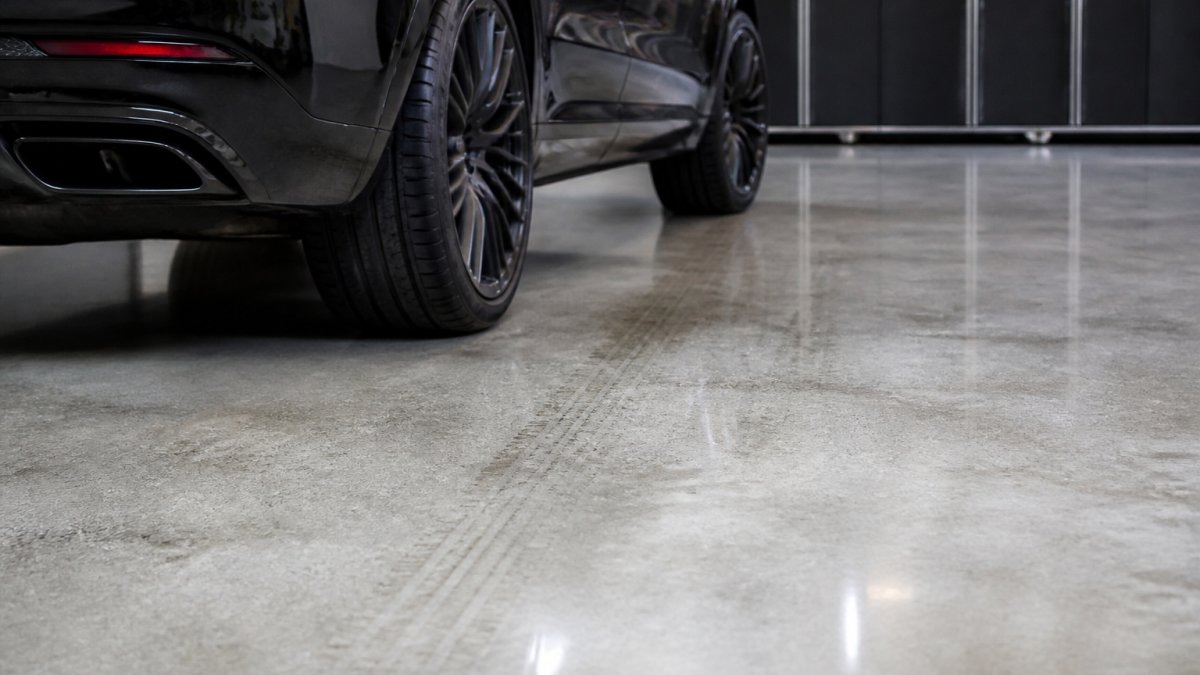
This is where the choice becomes practical. How your garage floor performs depends on what you actually do in the space. The table below is a garage-use test matrix: it compares how each surface handles the loads, heat, and chemicals a home garage actually sees.
Garage-use performance matrix
| Stress | Modular garage tiles | Polished concrete |
|---|---|---|
| Parked vehicle weight | Good to excellent; solid vinyl and composite resist point loads, thin polypropylene can flex | Excellent; designed for slab loads |
| Hot tires (50-70°C after highway driving) | Solid vinyl and rubber resist; cheap polypropylene can soften and warp | Unaffected |
| Floor jack and jack stands | Point loads can crack tile edges; use a plywood pad | Excellent, but dropped tools can chip |
| Oil and chemical spills | Sheds on surface; seeps into seams if not cleaned | Resists if sealed; unsealed concrete absorbs permanently |
| Road salt and brine | Resists surface damage; salt accumulates in seams | Can cause spalling and staining at edges and joints |
| Freeze-thaw cycles | Tiles flex with slab movement; seams can open | Vulnerable if slab has moisture or poor air entrainment |
| Wet traction | Textured tiles good; smooth tiles slippery | Slippery when wet unless anti-slip additive used |
| Rolling loads (creepers, dollies) | Small wheels can catch seams | Smooth; excellent |
Mechanisms behind the differences
Vehicle weight and tire pressure. A typical passenger car puts roughly 500-700 kg on each tire, and the contact patch is small, so the local pressure is high.
Hot tires. A tire can reach 50-70°C after highway driving. Polished concrete is unaffected. Some polypropylene tiles soften at those temperatures and take a set, leaving permanent depressions.
Oil and chemical spills. Polished concrete resists staining only if the sealer is intact. Once the sealer wears, oil penetrates and becomes a permanent stain.
Road salt and brine. Salt is the biggest long-term threat to polished concrete in cold climates.
Impact and dropped tools. Polished concrete chips at edges and can crack under a dropped heavy tool. Tiles absorb impact better but can crack at the interlock.
If your slab has visible cracks, efflorescence, or a history of moisture, fix the slab before either finish. Tiles will telegraph the movement and polished concrete will spall.
What this means for your use case
- Daily-parked vehicles, hot tires, road salt: solid vinyl or composite tiles on a sound slab, or polished concrete with a maintained sealer and anti-slip additive.
- Workshop with jacks and heavy tools: polished concrete with a mat at the work zone, or rubber tiles for comfort and impact absorption.
- Occasional parking, budget priority: mid-grade interlocking tiles self-installed.
The honest answer is that neither surface is indestructible. The difference is how damage shows up and how much it costs to fix.
Maintenance and Cleaning: Long-Term Effort and Costs
Maintenance requirements differ significantly, and this difference compounds over years.
Polished concrete needs regular sealing, typically every 2-3 years, depending on traffic and environmental exposure. Sealing costs vary but add up over time.
Tiles require more frequent attention but simpler cleaning. Sweep regularly to prevent dirt from accumulating in seams. Mop with standard floor cleaner.
The real maintenance burden with tiles is seam management. Seams collect everything, dust, oil, salt, moisture. Ignoring them leads to visible discoloration and potential mold growth. Polished concrete eliminates this problem entirely.
For homeowners who prefer low-maintenance solutions, polished concrete wins if properly sealed and protected from salt and moisture. For those willing to do basic seam cleaning, tiles are manageable.
Installation, Disruption, and Timeline
How quickly you can use your garage again matters, especially if it’s your primary workspace or vehicle storage.
Garage floor tiles can be installed in 1-2 days, often by homeowners themselves. There’s no curing time, you can park on the floor immediately.
Polished concrete requires 5-7 days minimum for professional installation.
If your concrete slab requires significant prep work, patching deep cracks, filling voids, or leveling, add another 2-3 days.
For homeowners who need their garage functional quickly, tiles are the clear winner. For those who can plan around a week-long installation window, polished concrete offers the seamless result.
Choosing between garage floor tiles and polished concrete comes down to your priorities: flexibility and quick installation (tiles) versus seamless durability and refined appearance (polished concrete).
At Lux Garages, we help homeowners evaluate these options based on their specific needs, whether you’re building a vehicle showroom, a functional workshop, or simply upgrading your home’s value. Our team specializes in professional-grade flooring systems and complete garage design.
Frequently Asked Questions
Are garage floor tiles better than polished concrete?
Neither is universally better, it depends on your priorities. Garage floor tiles offer easier installation, quick replacement of damaged sections, and better comfort underfoot. Polished concrete provides a seamless, high-end appearance and lower maintenance once sealed. For vehicle protection and longevity, polished concrete with proper sealing typically outperforms tiles. For flexibility and DIY-friendly repairs, tiles win. Consider your climate, vehicle type, and how long you plan to keep the garage.
How much does it cost to install garage floor tiles compared with polishing concrete?
Garage flooring cost comparison depends on slab size, existing concrete condition, and material quality. Interlocking garage floor tiles typically cost less upfront and require no surface preparation, making them budget-friendly for quick installations. Polished concrete involves grinding, sealing, and professional application, which increases initial expense but spreads costs over a longer lifespan. Pricing varies significantly based on your specific project, so request quotes from professional installers for accurate estimates tailored to your space.
Can garage floor tiles handle vehicle weight and hot tires?
Quality interlocking garage floor tiles are engineered to handle vehicle weight and hot tires when properly installed over a stable concrete base. However, sustained heat from parked vehicles and repeated thermal cycling can cause tiles to warp or shift over time. Polished concrete, when sealed correctly, resists hot-tire marks and thermal stress better. For luxury or high-performance vehicles parked frequently in hot conditions, polished concrete offers superior protection. Standard tiles work well for occasional vehicle use and lighter-duty garages.
Which garage flooring option is easier to maintain: tiles or polished concrete?
Polished concrete is simpler to maintain long-term. It requires regular sweeping and occasional resealing (every 1-3 years depending on traffic). Garage floor tiles demand more attention: debris collects in seams, grout can stain, and individual tiles may need replacement. However, tiles allow spot repairs without affecting the entire floor. Polished concrete demands professional resealing and cannot be partially replaced. Choose tiles if you prefer hands-on maintenance flexibility; choose polished concrete for minimal upkeep.