Garage Showroom Design for Collectors: The Ultimate Guide
Table of Contents
- Why Garage Showroom Design for Collectors Is Different
- Car Collector Garage Ideas That Actually Work
- Showroom Garage Lighting: See the Car, Not the Glare
- Garage Flooring for Car Collectors: Built for Tires and Jacks
- Garage Climate Control: Protecting Paint, Rubber and Chrome
- Security, Storage and Workshop Zones in a Collector Showroom
- Budget, Timeline and Design Decisions: What to Expect
- Frequently Asked Questions
Last Updated: October 18, 2026
Why Garage Showroom Design for Collectors Is Different
A collector’s garage is not a parking space. Garage showroom design for collectors is the discipline of turning a working structure into a climate-stable, lit, secure display environment where vehicles can be seen, maintained and protected at the same time. We plan these spaces around three demands that ordinary garage renovations ignore: presentation, preservation and access.
Most garage makeovers stop at storage and a clean floor. A collector’s showroom has to do more. Paint and chrome read differently under bad light. Rubber and leather age faster in a garage that swings between humid summers and deep winter cold. And a car you cannot walk around comfortably is a car you stop enjoying.
That tension, between a room that looks like a gallery and a room that works like a shop, is the throughline of every decision below. Get it right and the space earns its keep. Get it wrong and you have an expensive room that protects nothing.
Car Collector Garage Ideas That Actually Work
The strongest car collector garage ideas start with circulation, not decoration. Decide the walking path around each vehicle before you choose a single finish. A showroom needs roughly a metre of clear space on the sides you use most, and more at the front so doors open without touching a wall.
From there, the ideas that hold up in practice:
- A defined display bay with its own lighting and floor treatment, so one car reads as the centerpiece
- Perimeter cabinetry that keeps tools and supplies out of the display zone entirely
- A raised or contrasting display plinth to separate the hero car from the working floor
- Wall-mounted art and memorabilia positioned at eye level, not above the roofline
- A dedicated detail bay with drainage and power, kept visually separate from the display area
What most guides miss is that display and function fight each other unless you zone them early. Collectors who plan zones on paper avoid the common mistake of building beautiful cabinetry in the one spot they later need for a lift or a workbench.
Showroom Garage Lighting: See the Car, Not the Glare
Showroom garage lighting is a layered system, not a row of ceiling fixtures. The goal is to reveal body lines and paint depth while keeping reflected glare out of the viewer’s eye. That means combining ambient, task and accent light, each on its own control.
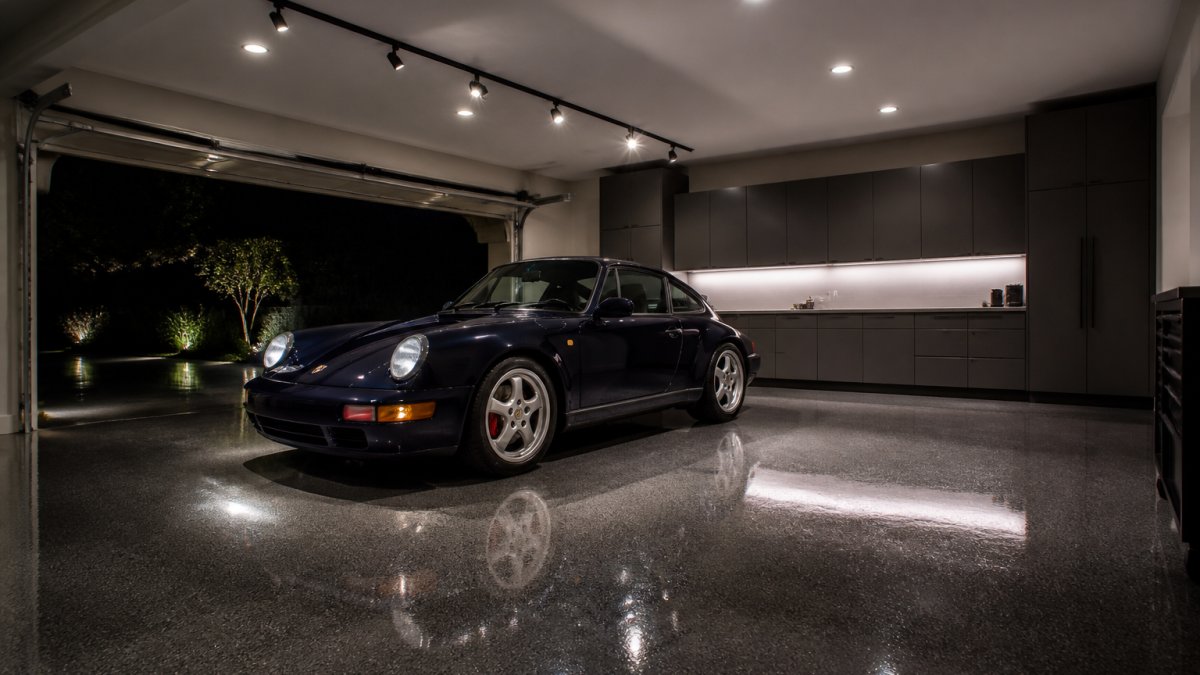
Layered Lighting for Depth and Detail
Ambient light fills the room evenly. Accent spots graze the flanks of a car to show curvature. Task light sits over the workbench and detail area. Put them on separate switches or dimmers so you can run the room as a gallery for guests and as a workshop for maintenance.
Color Temperature and CRI: The Specs That Matter
Two specifications decide whether paint looks true. Color temperature, measured in kelvin, sets the warmth of the light; a neutral range around 4000K keeps most finishes honest without looking clinical. Color rendering index measures how accurately a light shows color, and higher values reveal deep paints and metallics properly. Ask for the CRI figure before you commit, because cheap fixtures hide it.
Aim accent fixtures across the car’s flanks rather than straight down at the roof. Cross-lighting shows body lines and hides the flat, washed-out look that straight-down light creates on dark paint.
Garage Flooring for Car Collectors: Built for Tires and Jacks
Garage flooring for car collectors has to survive point loads from jacks and stands, hot tire pickup, and chemical spills, while still looking good enough to display on. A coating that only looks the part will fail under a jack in the first season.
Professional-grade epoxy and polyaspartic systems are the practical answer. Polyaspartic topcoats cure faster and resist UV yellowing better than standard epoxy, which matters in a room with large windows. Preparation decides the outcome: a floor that is not properly ground and cleaned before coating is the floor that peels.
The most common flooring failure is a coating applied over a damp or poorly prepared slab. Moisture vapour drives the coating off from below, and no warranty covers a floor that was never prepped for the conditions.
Ask any installer what surface preparation they use and how they test for moisture before quoting. If the answer is vague, walk away.
Garage Climate Control: Protecting Paint, Rubber and Chrome
Garage climate control is the least visible part of a collector showroom and the one that protects the most value. Vehicles left in a garage that swings with the seasons face condensation on cold metal, rubber that hardens, and leather that dries and cracks.
The practical approach is to hold the space stable rather than chase a perfect number. Insulate the envelope first, seal drafts, then size heating and ventilation to keep temperature and humidity from swinging sharply. A well-sealed, insulated garage does more for preservation than an oversized heater.
Schedule Your Private Garage Design Consultation →
- Insulate walls and ceiling, and seal the door
- Manage humidity, not just temperature
- Keep ventilation so fumes and moisture do not linger
- Avoid parking a wet car in a sealed room without airflow
Envelope integrity, electrical and ventilation work together here. Treat climate control as part of the build, not an add-on after the cabinetry goes in.
Security, Storage and Workshop Zones in a Collector Showroom
Security, storage and workshop zones should be designed as three separate systems that share one plan. Security covers access control, lighting on motion, and sightlines that do not advertise what is inside. Storage keeps supplies, tools and seasonal items out of the display bay. The workshop zone gives you a place to work without dragging equipment past the cars.
A simple way to lay this out:
| Zone | Purpose | Design priority |
|---|---|---|
| Display bay | Showcase the hero car | Lighting and clear circulation |
| Detail bay | Washing and maintenance | Drainage, power, ventilation |
| Workshop | Tools and repairs | Benches, storage, task light |
| Storage | Supplies and seasonal items | Closed cabinetry, out of sight |
Keep the workshop and detail zones visually separated from the display bay with cabinetry or a half-wall. That separation is what lets one room serve both purposes without compromise.
Budget, Timeline and Design Decisions: What to Expect
Pricing for a collector showroom depends on scope, so we quote each project individually rather than publish a figure that will not fit your space. A focused lighting and flooring upgrade sits at a very different level from a full build with climate control, custom cabinetry and structural work. The honest answer to “what will this cost” is that the number follows the decisions, and we would rather scope it properly than guess.
Timeline works the same way. Flooring and lighting can move quickly; climate, electrical and cabinetry take longer because they depend on the building. A realistic schedule starts with a design consultation, moves through specification and approvals, then build and finishing.
Decide your priorities before you price anything. Rank display, preservation and workshop use in order, and the budget conversation becomes far simpler, because you are funding what matters rather than everything at once.
On value, a well-executed showroom improves how the space functions and how the property presents, which is what buyers respond to.
A collector’s showroom only works when presentation, preservation and function are planned together from day one. That is exactly how Lux Garages approaches every project: complete design and build services, professional-grade epoxy and polyaspartic flooring, high-efficiency lighting, custom cabinetry, and expertise across the building envelope, electrical and plumbing, all backed by the longest warranties available. If you have a collection that deserves a proper home, schedule your private garage design consultation with Lux Garages and turn the space you have into a showroom built to last.
Frequently Asked Questions
How do you design a garage showroom for a car collection?
Start with the cars: measure every vehicle, including mirrors and open doors, then map turning circles and door swing. Garage showroom design for collectors works best when you separate display, storage and workshop zones before finishes are chosen. Plan lighting and power drops around the display bays, specify flooring rated for tire loads and jacks, and add climate control if the collection includes classics. A design-build team can coordinate the building envelope, electrical and cabinetry so the finished room looks intentional rather than assembled.
What lighting works best in a car showroom garage?
Showroom garage lighting usually combines three layers: broad ambient light from recessed ceiling fixtures, focused accent light on each car, and task lighting over workbenches. Look for fixtures with a color rendering index of 90 or higher and a color temperature around 4000K to 5000K so paint and chrome read accurately. Avoid a single row of high-output lights directly overhead, which creates hot spots on the roof and hood. Dimmable circuits let you switch between a bright working environment and a softer display mood.
What flooring is best for a collector’s garage?
Garage flooring for car collectors needs to handle tire loads, jack stands, chemical spills and repeated cleaning. Professional-grade epoxy and polyaspartic systems bond to a properly prepared slab and resist hot tire pickup, which is the peeling most homeowners complain about. The key is surface preparation: grinding or shot-blasting the concrete, repairing cracks and applying a moisture-tolerant primer before the color coat. A written warranty from the installer matters as much as the product brand.
How do you protect collector cars from moisture and temperature changes?
Garage climate control is the main defense. Aim for a stable temperature and moderate humidity rather than dramatic swings, and seal the building envelope so outside air and moisture stay out. A ducted heat pump or mini-split can hold conditions steady through winter, while a dehumidifier handles damp shoulder seasons. Insulate the overhead door and seal the perimeter, because an unsealed door undermines any system you install. Monitoring with a hygrometer helps you spot problems before they reach the paint.
How can a garage showroom also function as a workshop?
Zoning makes it possible. Place display bays along the back or side wall, keep the workshop bench and tool storage in a separate bay, and use custom cabinetry to hide consumables behind closed doors. A slop sink, dedicated 240-volt circuits and a sealed wall between grinding work and parked cars limit dust and fumes. The showroom side can stay gallery-clean while the workshop side gets the ventilation and power it needs. Discuss the split with your designer early, since it affects electrical and HVAC layout.
How much space do you need for a car collection garage?
A single car needs roughly 3 by 6 metres of clear floor to park and open doors comfortably, and more if you want walkaround space for detailing. For multiple cars, add circulation aisles and storage depth along the walls. Ceiling height matters too if you plan a four-post lift, which typically needs about 3.6 metres to the ceiling. Measure your actual vehicles rather than relying on standard bay sizes, then let the layout follow the measurements.