
How to Choose the Best Garage Wall Finish for a Home Workshop
Last Updated: October 25, 2026
Quick Summary
The best garage wall finish for a home workshop depends on your climate and budget: plywood and moisture-resistant drywall suit humid regions, while standard drywall works in dry, climate-controlled garages. A garage wall finish must resist moisture, impacts, and vibration while supporting tool mounting, with proper preparation and maintenance extending its life to decades.
- Plywood resists moisture and mounts tools anywhere without finding studs, but needs repainting every 4-6 years.
- Standard drywall is affordable but fails in moist environments; moisture-resistant drywall costs more but handles humidity spikes.
- Metal and aluminum composite panels last 10+ years with minimal maintenance, ideal for working shops despite higher upfront cost.
- Tool mounting requires planning: plywood and board-and-batten accept fasteners anywhere, while drywall needs studs or blocking.
- Semi-gloss or satin paint resists dust better than flat finishes and typically lasts 7-10 years with premium garage paints.
Table of Contents
- Why Your Garage Wall Finish Matters for a Workshop Space
- Drywall vs Plywood Garage Walls: Key Differences
- Garage Wall Panels: Metal, MDF, and Board-and-Batten Options
- Best Paint for Garage Walls: Color and Performance
- Garage Wall Finishing Cost: Budget Comparison and Installation
- Workshop-Specific Performance: Moisture, Durability, and Tool Mounting
- Planning Your Garage Wall Finish: Climate, Preparation, and Next Steps
- Frequently Asked Questions
Why Your Garage Wall Finish Matters for a Workshop Space
A garage wall finish is more than cosmetic: it protects tools, vehicles, and equipment, prevents moisture damage, resists impacts, and supports tool mounting.
The wrong choice can cause peeling paint, water stains, and damaged drywall within five years. The right finish, paired with proper preparation, can last decades.
Workshops face temperature swings, humidity spikes, impacts, vibration, dust, and heavy mounting, so a garage wall finish must balance durability, maintenance, cost, and aesthetics.
Drywall vs Plywood Garage Walls: Key Differences
Choosing between drywall and plywood comes down to moisture tolerance, durability, and tool mounting. Both are common garage wall finishes, but they handle the workshop environment very differently.
Drywall looks smooth and is affordable and easy to install, but standard drywall absorbs moisture and can swell, warp, and fail.
Plywood resists moisture better and mounts tools anywhere without finding studs. It’s tougher against impacts and vibration, but looks rougher and needs more finishing.
Drywall: Smooth Finish and Moisture Considerations
Standard drywall delivers a clean, painted surface and is the cheapest option, working well in climate-controlled, low-humidity garages.
The catch: regular drywall fails in moist environments. If your garage experiences temperature swings or humidity spikes, moisture wicks into the drywall core, causing:
- Soft spots and sagging
- Mold and mildew growth
- Paint peeling and bubbling
- Structural deterioration
Moisture-resistant drywall (“green board” or “blue board”) uses a moisture-resistant core and face paper, making it the drywall choice for climates with seasonal moisture.
Even moisture-resistant drywall isn’t waterproof: it handles elevated humidity but not direct water. Pair it with proper ventilation and drainage.
If you choose drywall, expect to repaint every 5-7 years as the finish wears from dust, impacts, and UV exposure from garage lighting.
Plywood: Durability and Tool Mounting
Plywood shrugs off moisture swings that destroy drywall.
Plywood works well for pegboards, shelving, tool racks, or cabinets, with mounting flexibility and no backing boards needed.
The visual tradeoff is real: plywood has visible grain and edge seams. Paint helps, but it never looks as smooth as finished drywall.
Plywood also needs more maintenance: the porous surface collects dust, so you’ll clean and repaint roughly every 4-6 years depending on workshop use.
Garage Wall Panels: Metal, MDF, and Board-and-Batten Options
Beyond drywall and plywood, three other materials deliver different strengths for workshop walls.
Metal Sheeting and Aluminum Composites
Metal panels (steel or aluminum) resist moisture completely, handle impacts without denting easily, and need minimal maintenance, which is why industrial workshops favor them.
Metal sheeting creates a modern, industrial look and reflects light well. Installation is straightforward: panels screw or bolt to the wall frame.
The downsides: metal is noisy, needs special fasteners for tool mounting, costs more upfront, and conducts temperature, so the garage feels colder in winter.
Aluminum composites blend metal durability with easier tool mounting. They’re lighter than steel, resist corrosion, and accept standard fasteners.
MDF and Paintable Surfaces
Medium-density fiberboard (MDF) offers a smooth, paintable, splinter-free surface more refined than plywood but cheaper than drywall.
MDF takes paint beautifully and looks polished, popular in garages where aesthetics matter, such as car-collection showrooms.
The limitation: MDF is moisture-sensitive and swells when exposed to humidity or water. It suits climate-controlled garages; in damp environments it fails faster than plywood.
MDF also dents and dings more easily than plywood, and the damage is harder to repair invisibly.
Schedule Your Private Garage Design Consultation →
Board-and-Batten Wall Treatments
Board-and-batten combines vertical boards (typically 1×10 or 1×12 lumber) with thin trim strips covering the seams for a cottage or farmhouse look.
Board-and-batten suits a finished, designed look: it hides wall-frame imperfections, accepts stain or paint easily, and mounts tools anywhere like plywood.
The tradeoff is labor and cost. Installation takes longer than drywall or panels. The vertical boards also collect dust in the seams, requiring more frequent cleaning.
Best Paint for Garage Walls: Color and Performance
Once you’ve chosen your wall material, paint selection shapes both durability and appearance.
Color choices affect the space. Bright white maximizes light reflection but shows dirt quickly.
Many workshops use a combination: bright white or light gray on upper walls for light reflection, with darker trim or lower walls to hide wear.
Epoxy or polyurethane-based paints outperform latex for workshop walls. They’re tougher, more moisture-resistant, and cleaner to maintain.
Garage Wall Finishing Cost: Budget Comparison and Installation
Most guides stop at ‘cheap, mid-range, expensive.’ What you actually need is a per-square-foot installed cost, because a 400 sq ft two-car garage and a 700 sq ft shop differ by thousands of dollars even when the material is the same.
| Material | Material Cost (per sq ft, CAD) | DIY Install Difficulty | Paint/Finish Add-On (per sq ft, CAD) | Expected Repaint Cycle |
|---|---|---|---|---|
| Standard drywall (1/2 in) | $1.25-$2.00 | Easy | $0.60-$1.20 | 5-7 years |
| Moisture-resistant drywall | $1.75-$2.75 | Easy | $0.60-$1.20 | 5-7 years |
| Plywood (1/2-5/8 in) | $2.00-$3.50 | Easy | $0.80-$1.50 | 4-6 years |
| MDF panels | $1.75-$3.00 | Easy | $0.70-$1.30 | 5-7 years |
| Board-and-batten (lumber + trim) | $3.00-$5.50 | Moderate-difficult | $0.80-$1.60 | 6-8 years |
| Steel or aluminum sheeting | $4.00-$8.00 | Moderate | Minimal | 10+ years |
| Aluminum composite panels | $5.00-$9.00 | Moderate | Minimal | 10+ years |
What the table hides. Material cost is only part of the total.
Labor changes the ranking. Drywall and plywood are realistic DIY projects; board-and-batten and metal panels stretch timelines due to cuts, miters, and careful seam layout.
Long-term upkeep is part of the cost. A $2.00 per sq ft finish repainted every four years isn’t cheaper than a $5.00 per sq ft panel needing a wipe-down. Over 15 years, repaint cycles add $1.00-$2.50 per sq ft in paint and prep, plus your time. Metal and aluminum composite panels usually win the lifetime comparison in a working shop; drywall wins day one in a climate-controlled garage.
Price the whole wall, not the sheet. Measure wall height times wall length, subtract openings for doors and windows, then add 10 percent for cuts and waste. That number, multiplied by the per-square-foot band above, gives you a realistic material budget before you shop.
Pricing also depends on wall size, existing wall condition, and local labor rates. For a detailed breakdown tailored to your project, schedule your private garage design consultation that accounts for your specific dimensions and finish choices.
Workshop-Specific Performance: Moisture, Durability, and Tool Mounting
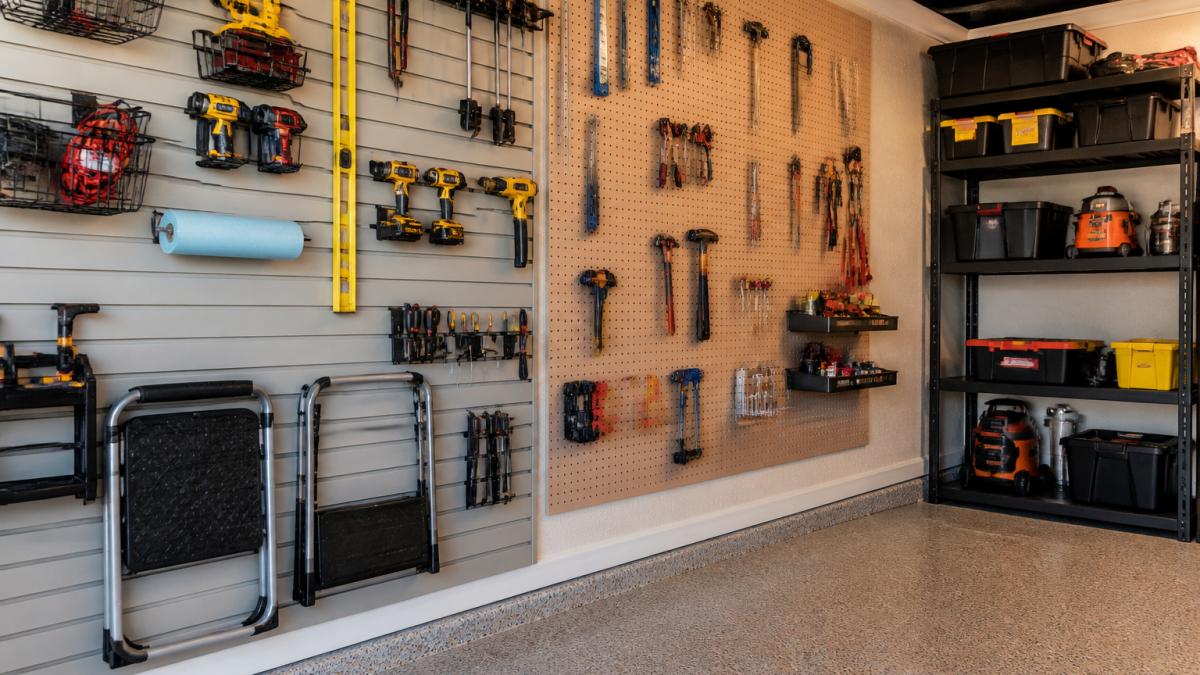
A workshop wall has to do three jobs at once: keep moisture out of the assembly, survive impacts and vibration, and hold whatever you hang on it. Most guides cover the first two and skip the third, which is the one that actually fails in a working shop.
Moisture resistance is about the assembly, not just the face. Plywood, metal, and moisture-resistant drywall tolerate humid air, but the wall behind them still needs a path for vapor to escape.
Durability is mostly about what happens at the fastener. Drywall dents and crumbles around a screw head on impact; plywood and metal spread the load.
Tool mounting is where the materials separate. This is the part the generic guides leave out:
- Plywood: fasteners bite anywhere, so a pegboard, French cleat, or cabinet can go up without hunting studs. For heavy loads, drive structural screws into studs and use the plywood as a backer, not as the sole support.
- Drywall: you must find studs or install blocking. A cabinet holding paint or power tools needs blocking behind the drywall; toggle bolts alone are a poor choice for anything that vibrates.
- Metal panels: standard screws can strip or wallow in thin sheet. Use self-drilling screws with washers, and plan panel layout so seams land on studs so you have something solid to anchor into.
- Board-and-batten: the battens themselves are a mounting surface, and the vertical boards give you continuous nailing. It is one of the easiest finishes to hang from, provided the boards are fastened to studs, not just to the sheathing.
- MDF: holds light loads, but screw threads pull out more easily than in plywood, and a wet MDF panel loses holding power fast.
Match the finish to the load, not the look. A wall holding a clock and a shelf differs from one holding a 200 lb cabinet of bolts and an air hose reel. Decide what hangs where before choosing the panel, because retrofitting blocking behind a finished wall is far more work than installing it up front. Explore slatwall and storage systems that complement your wall finish and maximize vertical organization.
Do not hang a heavy cabinet or tool chest from drywall alone, and do not rely on the panel face to carry a load that should go into studs. Vibration from shop equipment works fasteners loose over months, and a failure usually happens when the wall is fully loaded.
Planning Your Garage Wall Finish: Climate, Preparation, and Next Steps
Your climate is the deciding factor.
Existing wall condition also matters. If your concrete or block walls have cracks or water seepage, address that before finishing.
Proper ventilation prevents moisture problems. Install exhaust fans or ensure your garage has adequate air circulation to manage humidity spikes.
Before committing to materials, clarify what your workshop needs to do: vehicle showroom, tool-heavy workspace, or both?
These questions shape your finish choice. Start your project by telling us about your garage dimensions, climate, and vision.
Choosing the right garage wall finish transforms a bare utility room into a functional, durable workspace. Whether you’re building a showroom for a car collection or a tool-heavy workspace, we can design a complete garage transformation with professional-grade materials and expert installation.
Frequently Asked Questions
What is the most durable garage wall finish for a workshop?
Metal sheeting and high-quality plywood are the most durable options for high-impact workshop environments. Metal panels resist dents and moisture, while plywood handles tool mounting and impacts well. For the longest-lasting finish, combine a durable substrate with moisture-resistant paint or epoxy coating. The choice depends on your climate and how heavily you use the space. Consult a professional to assess your specific workshop demands and local humidity levels.
Should I use plywood or drywall for garage workshop walls?
Plywood is better for workshop walls because it handles tool mounting, impacts, and humidity better than standard drywall. Plywood allows you to hang cabinets, pegboards, and heavy equipment directly into studs. Moisture-resistant drywall works in drier climates but requires a vapor barrier and is more prone to damage in active workshops. Your choice depends on your climate, how much you use the space, and your budget. Professional assessment of your garage’s moisture levels and insulation will help determine the best option.
What type of paint is best for garage workshop walls?
Use a high-quality garage wall paint designed for moisture and durability, such as semi-gloss or satin-finish enamel paint. These finishes resist stains, dust, and humidity better than flat paint. Light colors like bright white reflect light and make workshops feel larger, while darker colors hide dirt and dust. Choose paint rated for garages and workshops specifically, as standard interior paint won’t withstand temperature swings and moisture. Apply primer first to ensure proper adhesion and durability.
Do I need a vapor barrier in my garage workshop?
A vapor barrier is important in garages, especially in humid climates or where temperature swings are extreme. It prevents moisture from entering wall cavities and causing mold or structural damage. If you’re using drywall, a vapor barrier behind the drywall is essential. Plywood and metal panels are more forgiving but still benefit from proper ventilation and moisture management. Your local climate and the garage’s existing insulation determine whether a vapor barrier is critical. A professional can assess your specific situation and recommend the right approach.
