Garage Living vs The Garage Store: A 2026 Comparison
Table of Contents
- Garage Living vs The Garage Store: Two Franchise Models, One Decision
- How a Franchise Network Changes Your Project
- Side-by-Side Comparison: Services, Materials, and Warranty
- What a Garage Renovation Cost Actually Includes
- The Garage Makeover Process, Step by Step
- Questions to Ask Garage Contractors Before You Sign
- Your Garage Renovation Quote Checklist
- Which Provider Fits Your Project?
- Frequently Asked Questions
Last Updated: October 14, 2026
Garage Living vs The Garage Store: Two Franchise Models, One Decision
Garage Living and The Garage Store both sell garage transformations through franchise networks, and that shapes everything about your project.
Here is what most homeowners miss: when you hire a franchise, you are hiring a local owner who bought into a system.
Below, we compare both models side by side, then hand you a quote checklist and questions to ask garage contractors before you sign.
The franchise name on the estimate tells you what products are available. The local franchisee tells you what quality you actually get. Judge both.
How a Franchise Network Changes Your Project
A franchise network standardizes products and processes, bringing consistency but limiting customization.
That is not automatically bad. Standardized systems give the franchisee a playbook: set cabinet lines, flooring products, and installation methods. You get predictability.
The trade-off is flexibility.
Service area is the other variable. Franchise coverage is only as good as the local operator, a stretched or newly opened franchisee can hurt your timeline and finish quality.
Side-by-Side Comparison: Services, Materials, and Warranty
Most pages ranking for this query describe one brand’s catalog, which does not answer the question you typed. Here is the honest comparison: what each network sells, where products diverge, and what the warranty really covers.
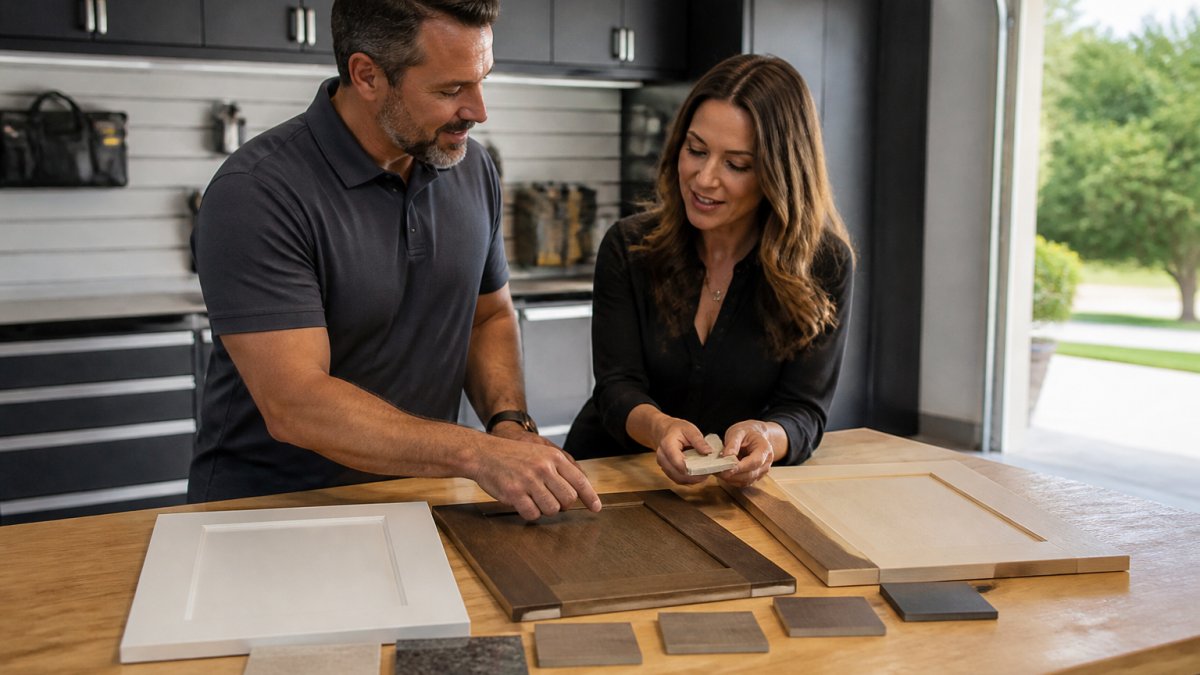
What each network sells
Both are franchise networks: the parent brand sets the product catalog, and the local franchisee sells, designs, and installs from it. The catalogs overlap heavily:
- Cabinetry and wall storage, both offer modular cabinet lines, workbenches, overhead racks, and slatwall or panel-based hanging systems.
- Flooring, both offer coating systems (epoxy and polyaspartic blends) and, in some territories, interlocking tile.
- Lighting and electrical accessories, LED fixtures, task lighting, and outlet additions, usually subcontracted to a licensed electrician.
The meaningful differences are not in the category list but in three places: cabinet construction, flooring chemistry, and who holds the warranty.
Cabinet construction and finish
| Factor | Garage Living | The Garage Store |
|---|---|---|
| Business model | Franchise network | Franchise network |
| Cabinet construction | Cabinet and slatwall systems built to the parent brand’s spec | Cabinet and shelving systems built to the parent brand’s spec |
| Finish options | Parent-brand finish palette; local franchisee may add options | Parent-brand finish palette; local franchisee may add options |
| Flooring systems | Coating systems (epoxy / polyaspartic) and select tile options | Coating systems and select tile options |
| Warranty | Set and honored at the franchise level | Set and honored at the franchise level |
| Customization | Standard product lines; limited one-off fabrication | Standard product lines; limited one-off fabrication |
| Service area | Local franchisee coverage only | Local franchisee coverage only |
Two practical reads from that table:
- Cabinet construction is a spec question, not a brand question. Ask both providers for the cabinet box material (typically melamine-faced particleboard, plywood, or composite), door material, hinge and drawer-slide brand, and edge-banding method. A franchisee who cannot answer those four questions in writing is selling a catalog, not a system.
- Finish options are the most common reason a franchise quote gets rejected. If your garage needs a color or door profile outside the parent palette, the franchisee usually cannot source it. An independent shop can.
Flooring systems
Both networks sell coating systems rather than interlocking tile by default. The chemistry matters more than the brand name on the bucket:
- Epoxy, hard, glossy, and inexpensive, but it can yellow under UV and is less flexible under thermal shock.
- Polyaspartic, faster cure, better UV stability, and more flexible, the common upgrade for garages that see freeze-thaw cycles and road salt.
- Surface prep, the biggest determinant of whether either coating lasts. Grinding or shot-blasting to the correct concrete profile (not acid etching) is standard practice; skipping mechanical prep is why peeling floors exist.
Ask which system is quoted, the dry-film thickness, and the prep method. Those three answers tell you more than the brand name.
Warranty: the fine print that decides the project
Both brands advertise warranties, but terms are set and honored at the franchise level, so two locations under the same banner can offer different coverage. Before you sign, get these in writing:
- Length, how many years, and does it start at installation or final payment?
- Coverage, does it cover cabinet boxes, doors, hardware, finish, and floor coating separately or as one package?
- Exclusions, water damage, slab movement, and improper use are commonly excluded. Ask which apply to you.
A national brand name does not guarantee a national warranty. If the local franchisee closes or sells, your coverage may not transfer cleanly. Get the warranty terms and the responsible party in writing before you sign.
Service area and showroom access
Franchise coverage is only as good as the local operator. Before you commit, confirm:
- The franchisee’s territory and how long they have operated in it.
- Whether the showroom is staffed by the franchisee or a third party.
- Whether the crew is employed or subcontracted, and who supervises the install.
Judge the local operator, not the logo.
Where the two networks are effectively the same
For a straightforward garage, a rectangular space, standard cabinet run, coating floor, and a few accessories, the two networks produce a similar result at a similar price. The decision comes down to the local franchisee’s reviews, warranty terms, and quote detail.
Where they both fall short
Complex projects, a vehicle display space, a combined workshop and showroom, structural or electrical coordination, or custom fabrication, sit outside the standard franchise playbook. Compare the franchise quote against an independent design-build firm; the gap is usually in customization and accountability, not the base product.
What a Garage Renovation Cost Actually Includes
No ranking page for this query gives you a usable cost structure. Here is one, framed for a Canadian project. Prices below are qualified ranges based on common market patterns, not quotes, your actual number depends on your slab, square footage, and finish choices.
The four cost buckets
A garage renovation quote should break into four lines. If it does not, ask for a revised quote before you compare.
Schedule Your Private Garage Design Consultation →
- Cabinetry and storage systems, usually the largest line item, priced by linear footage of cabinet run, depth, door style, and hardware. A single-wall run costs less than an L-shape or full wrap because cabinet count and installation labor both rise.
- Flooring, priced by square footage and system. Coatings (epoxy or polyaspartic) are quoted per square foot and include surface prep; interlocking tile is quoted per square foot plus edge trim. A typical two-car garage is roughly 400-500 sq ft; a single-car is roughly 200-250 sq ft.
- Lighting and electrical, fixtures, wiring runs, and any panel or circuit additions. Commonly underestimated because it depends on where your existing panel sits relative to the garage.
- Labor and installation, removal of existing shelving, slab prep, install, and cleanup. Confirm whether removal and disposal are included or billed separately.
What actually drives the price up
- Slab condition. A cracked, spalled, or oil-stained slab needs grinding, crack repair, and possibly a moisture test before any coating goes down, the most common hidden cost.
- Square footage. Flooring and lighting scale with size; cabinetry scales with linear footage, not floor area.
- Cabinet run length and configuration. A straight run is cheapest. Corners, islands, and overhead racks add material and labor.
Qualified example ranges
Use these as a sanity check, not a quote. They reflect common market patterns for a standard two-car garage in a major Canadian metro:
- Floor coating only, a professionally prepped and installed epoxy or polyaspartic system typically lands in the low-to-mid four figures, depending on square footage, system, and slab condition.
- Cabinet package only, a single-wall cabinet run with a workbench typically lands in the mid four figures; a full wrap with overhead storage pushes higher.
- Full transformation, flooring, cabinets, wall systems, and lighting together commonly land in the mid-to-high five figures for a standard two-car garage, and higher for a three-car or custom layout.
These ranges move with region, season, and material lead times. Treat any provider who quotes a firm number without inspecting your slab and measuring your space as a risk.
How to compare two quotes fairly
Two quotes can look similar on price while covering completely different scopes. Line them up on these points:
- Is surface prep (grinding, crack repair, moisture test) included or billed extra?
- Is removal and disposal of existing shelving included?
- Is the electrical work permitted and inspected, or handled off the books?
A low number that omits prep or electrical is not a lower price. It is an incomplete one.
Decision framework by budget and project type
- Under a few thousand dollars, storage only. Prioritize wall-mounted racks, slatwall, and a single cabinet run. Skip the floor coating until the budget allows a properly prepped system.
- Mid four figures, floor first. If your slab is sound, a professionally prepped coating is the highest-impact single upgrade. Add cabinets later.
- Five figures and up, full transformation. Sequence the work: floor coating first (let it cure fully), then cabinets and wall systems, then lighting and finishing. This order protects the coating and avoids rework.
Ask for the quote in writing with each of the four cost buckets itemized. A verbal ballpark is not a quote, and it is not comparable to anything.
For a project tailored to your space, request a written quote after an on-site slab inspection and measurement, not before.
The Garage Makeover Process, Step by Step
The garage makeover process follows a predictable sequence, and knowing it helps you spot a provider who is rushing. Here is how a well-run project moves from first call to finished space.
- Consultation and measurement – walk the space, discuss use, note electrical and structural needs
- Design and quote – layout, materials, finish options, and a written estimate
- Scheduling and prep – clear the garage, repair the slab, protect adjacent areas
- Flooring installation – grind, coat, and cure the floor before anything sits on it
- Cabinetry and wall systems – install storage, workbenches, and slatwall
- Lighting and finishing – fixtures, trim, final walkthrough
- Inspection and handover – review the work, confirm warranty, get documentation
Timeline varies with scope, material lead times, and cure schedules. Floor coatings need time to cure before heavy items go back in, so plan for vehicles to stay outside for a stretch.
Schedule the floor coating first and let it cure fully before cabinets go up. Installing storage over a half-cured floor traps moisture and shortens the coating’s life.
Questions to Ask Garage Contractors Before You Sign
The right questions separate a provider who stands behind the work from one who disappears after the final invoice. Ask these before you commit to any garage contractor.
- Who physically performs the installation, and are they employees or subcontractors?
- What is the exact warranty, what does it cover, and who honors it?
- How is the slab prepped before flooring, and what happens if it fails?
That last question matters. A provider with a clear revision process will explain exactly how changes are handled; one who dodges it is telling you something too.
Your Garage Renovation Quote Checklist
A garage renovation quote checklist keeps you from comparing apples to oranges. Two quotes can look similar on price while covering completely different scopes. Use this checklist to line them up.
- Itemized cabinetry: linear footage, material, and finish
- Flooring: system type, square footage, and prep method
- Lighting and electrical: fixtures, wiring, and any panel work
If a quote skips any of these lines, ask for it in writing before you compare. A low number that omits prep or electrical is not a lower price.
Which Provider Fits Your Project?
Both franchise models work for straightforward garage storage and organization projects where a standard product line fits your space.
Where franchises struggle is complex, custom work: a showroom for a vehicle collection, a combined workshop and display space, or a layout needing structural and electrical coordination. That is the work we do at Lux Garages.
The honest answer is that the brand matters less than the operator. Whether you choose a franchise or an independent firm, judge the local team, the written warranty, and the itemized quote.
Frequently Asked Questions
How much does a professional garage renovation cost?
Pricing depends on the size of the space, the storage systems you choose, flooring type, and any electrical or plumbing work. A basic organization package costs far less than a full custom build with cabinetry and epoxy flooring. Request itemized quotes from each provider so you can compare scope, materials, and warranty side by side rather than comparing a single lump sum.
What services should I compare when choosing a garage renovation company?
Compare design capability, cabinet construction and sheet thickness, flooring systems, electrical and lighting work, warranty length, and whether installation is handled in-house or subcontracted. A provider that handles design and build under one roof reduces the coordination burden on you.
How long does a garage renovation take?
Timelines depend on scope. A flooring-only project can finish in a few days, while a full makeover with custom cabinets, electrical, and lighting often runs several weeks. Ask each contractor for a written schedule with milestones and confirm how material lead times affect the start date. Get the timeline in the quote so delays are measurable.
Are epoxy garage floors worth the cost?
A properly installed epoxy or polyaspartic floor protects concrete from salt, oil, and hot tires, and it is far easier to clean than bare concrete. Longevity depends on surface preparation and product quality, not just the coating brand. Ask about the prep method, the number of coats, and the warranty covering peeling or hot-tire pickup before you commit.
Your garage should work as hard as the rest of your home, and a franchise template rarely gets you there. Lux Garages designs and builds custom garage interiors with complete design-build services, professional-grade epoxy and polyaspartic flooring, and the longest warranties available. Schedule your private garage design consultation and turn your underused space into a functional, valuable part of your property.