
How to Upgrade Your Garage for an Electric Vehicle
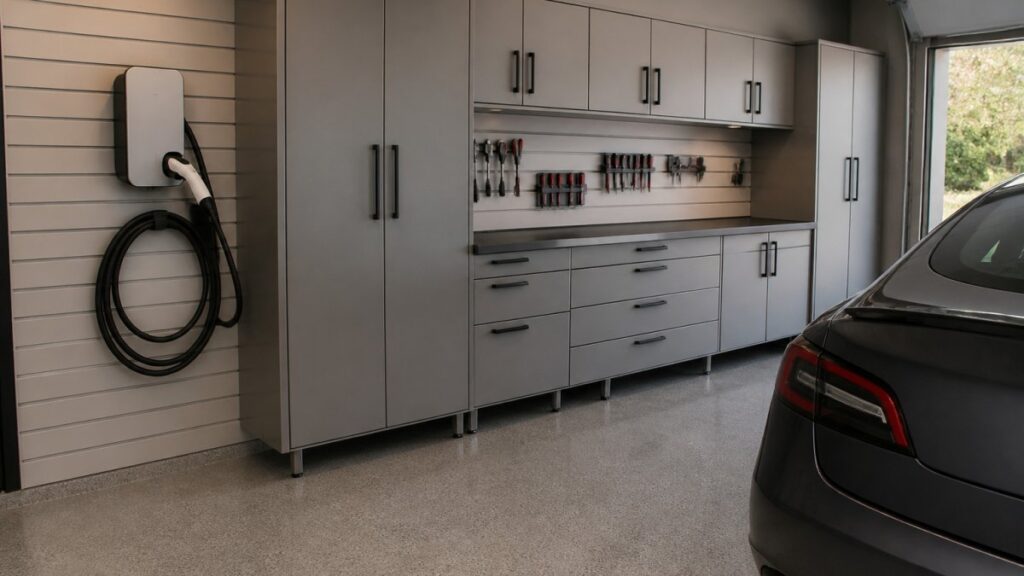
Last Updated: October 29, 2026
Quick Summary
The five garage upgrades for EV owners that matter most in Canada are a home EV charger, an electrical panel check, cable management, durable flooring, and lighting with storage. Start with the charger and panel, since they affect safety, permits, and cost.
- Level 2 charging uses a dedicated 240-volt circuit and is much faster than Level 1.
- Ask a licensed electrician for a load calculation before buying a charger.
- Confirm local permit requirements before installation and keep the inspection certificate.
- Store charging cables on a wall hook or retractable reel, off the floor.
- Epoxy and polyaspartic flooring resist oil, road salt, and moisture.
Table of Contents
- Why Your Garage Matters for EV Ownership
- 1. Install a Home EV Charger
- 2. Upgrade Your Garage Electrical Panel for EV Charging
- 3. Organize EV Charging Cable Management
- 4. Choose Garage Flooring for Electric Vehicles
- 5. Add Lighting, Storage and Climate Control
- Booking Your Garage Design Consultation
- Frequently Asked Questions
Electric vehicles are changing how Canadian homeowners think about their garages. A garage that once only stored a gas car now needs a charger, the right electrical capacity, and a layout that keeps cables out of the way. This guide from Lux Garages walks through the five garage upgrades for EV owners that matter most in Canada, in the order we recommend tackling them.
A garage is no longer just storage. It is where most EV owners charge overnight, so the space has to handle power, safety, and daily use. Getting these upgrades right the first time saves rework and keeps the project on budget.
Why Your Garage Matters for EV Ownership
Most EV owners charge at home, and the garage is usually the easiest place to do it. A dedicated space with a stable power supply makes charging simple and predictable. Without planning, however, a garage can end up with a cord running across the floor, an overloaded panel, or a charger mounted where it gets in the way, which is why smart garage upgrades for EV owners start with a clear plan.
Planning the garage around the vehicle makes everyday life easier. Charging, lighting, storage, and floor finish all work together, so it helps to think about them as one project rather than separate jobs.
1. Install a Home EV Charger
A home charger is the foundation of the upgrade. It turns your garage into a place where the car refills itself every night, and it is the one upgrade that touches electrical code, permitting, and insurance. Getting it right the first time matters more than any other item on this list.
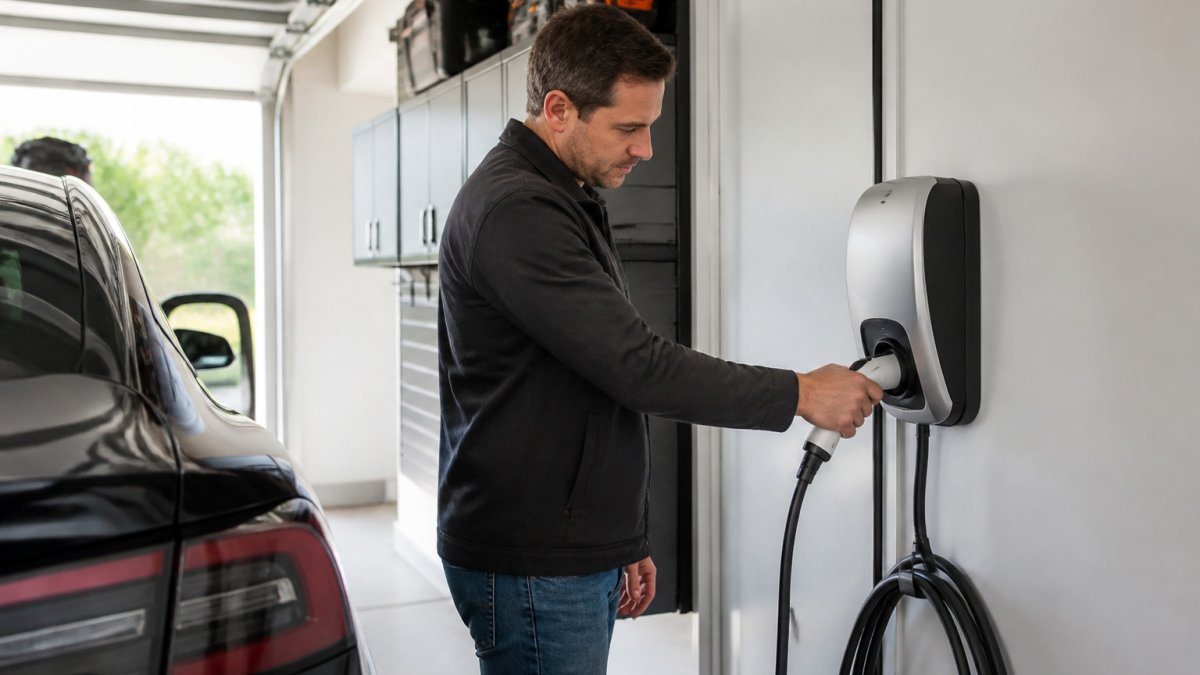
Level 1 Versus Level 2 Charging
Level 1 charging uses a standard 120-volt outlet and adds range slowly. Level 2 charging uses a dedicated 240-volt circuit and adds range much faster in the same window (Electric vehicle charging).
- Level 1: standard household outlet, slow, minimal setup, best for low-mileage drivers or as a backup
- Level 2: dedicated 240-volt circuit, much faster, the common home choice, requires a dedicated breaker
Confirm the actual circuit size with your electrician rather than guessing from the charger box.
Wall-Mounted Charger Placement
Mount the charger where the charging cable reaches the vehicle’s port without stretching. Keep it clear of doors, shelving, and the path you walk every day. Mounting height matters: a charger mounted too low lets the cable drag, and one mounted too high strains the port.
Plan for cable reach with the vehicle parked in its normal position, not pulled forward. If you may add a second EV later, consider a pedestal or a second circuit now rather than retrofitting later.
Permits, Licensing, and Insurance
This is where many homeowners get caught. Permit and licensing requirements for EV charger installation vary by location. Confirm local requirements before work starts. Confirm local permit requirements before work starts, and keep the inspection certificate with your home records.
Do not buy the charger before the electrician confirms your panel capacity and circuit plan. A charger that does not match your service can sit in the box while you pay for a panel upgrade.
What Drives the Cost
Charger hardware and installation are separate line items. Ask for a written quote that separates hardware, wiring, labor, permit, and inspection so you can compare bids fairly. Pricing depends on the scope of your project; visit the Lux Garages website to request a quote.
Find a licensed electrical contractor in your province
Schedule Your Private Garage Design Consultation →
Charger Features Worth Paying For
Not every smart feature earns its price. Useful ones include adjustable amperage (so the charger can share capacity with the rest of the home), scheduling (to align with time-of-use rates), and a weather-rated enclosure if the unit is mounted near a garage door. Features like Wi-Fi and app control are convenient but should not come at the expense of a properly sized circuit.
Treat the charger as an electrical project first and a gadget second. The circuit, permit, and inspection are what make it safe and insurable.
The table below compares the two charging levels covered in this section.
| Charging level | Power source | Speed |
|---|---|---|
| Level 1 | Standard 120-volt outlet | Slow |
| Level 2 | Dedicated 240-volt circuit | Much faster |
2. Upgrade Your Garage Electrical Panel for EV Charging
Before installing a Level 2 charger, check whether your electrical panel can handle the extra load. Many older homes were built for far lower demand than a modern EV charger requires.
A licensed electrician can run a load assessment to see how much spare capacity the panel has. If there is not enough room, a panel upgrade may be needed. This step is often the biggest unexpected cost, so it is worth asking about early.
- Ask for a load calculation before buying a charger
- Confirm the panel amperage and remaining capacity
- Factor in a possible panel upgrade and permit fees
3. Organize EV Charging Cable Management
A charging cable left on the floor is a trip hazard and wears out faster. Good cable management keeps the space clean and protects the cable.
- Use a wall hook or retractable reel to store the cable off the floor
- Leave enough slack so the cable never pulls tight at the port
- Keep the cable away from heat sources and sharp edges
4. Choose Garage Flooring for Electric Vehicles
The floor takes daily wear from tires, spills, and foot traffic. Durable flooring makes the garage easier to clean and keeps it looking good for years.
Epoxy and polyaspartic flooring systems are among the options Lux Garages offers for garage floors, and they are designed to resist oil, road salt, and moisture. Ask for a clear written warranty and a clear explanation of surface preparation, since that step decides how long the finish lasts.
5. Add Lighting, Storage and Climate Control
Good lighting makes charging and cleaning safer and easier. Bright, even light also shows the car and the space at their best.
Storage keeps the floor clear. Wall cabinets and overhead racks hold tools, tires, and cleaning supplies so the charging area stays open. Climate control matters too, since extreme cold can slow charging and affect battery performance.
Booking Your Garage Design Consultation
Frequently Asked Questions
Do I need to upgrade my electrical panel to charge an EV at home?
Not always. Many homes can support a Level 2 charger on the existing panel, but a load assessment by a licensed electrician determines whether your panel has enough spare capacity. If it does not, a panel upgrade is usually needed before installing a dedicated 240-volt circuit. Ask for the assessment in writing so you know which work is required and whether a permit applies in your area.
How much does it cost to install a home EV charger?
Costs depend on your electrical service, the distance from the panel to the charger, the charger model and whether a panel upgrade is needed. Lux Garages does not publish fixed prices for EV charger work, so pricing depends on the scope of your project. Visit the Lux Garages website to request a quote and a consultation tailored to your garage.
What type of EV charger is best for a garage?
For most garages, a Level 2 charger is the practical choice because it adds range much faster than a standard 120-volt outlet. A Level 1 outlet can work for owners who drive short distances and charge overnight. Consider the charger’s amperage rating, whether it supports scheduled charging and how it will be mounted so the cable reaches your charging port without strain.
Ready to plan your EV-ready garage? Lux Garages designs and builds complete garage spaces, from custom cabinetry and epoxy flooring to high-efficiency lighting. Schedule your private garage design consultation to get started on a layout built around your vehicle.
