
Is Epoxy Floor Repair Worth It for Old Garages?
Last Updated: November 2, 2026
Quick Summary
Epoxy floor repair is worth it for old garages when the concrete slab is sound and the existing coating failed for a fixable reason, such as poor preparation or moisture. If the concrete itself is crumbling, dusting, or moving, repair will not last and concrete repair or replacement comes first.
- Professionally installed epoxy in a residential garage typically lasts 10 to 20 years.
- Test the bond with a putty knife; if coating lifts easily across a wide area, spot repair will not hold.
- Grind or shot-blast the entire surface, not just damaged patches, before recoating.
- Hairline shrinkage cracks are repairable, but wide or recurring cracks point to slab movement.
- Compare quotes on what each includes, since preparation and moisture work decide whether a floor lasts.
Table of Contents
- The Real Question: Repair or Replace Your Old Garage Floor
- Epoxy Garage Floor Lifespan: What You Should Expect
- Repair or Replace Garage Floor: A Decision Framework for Old Slabs
- How to Fix Peeling Epoxy Garage Floor Problems for Good
- Garage Floor Epoxy Cost: Repair, Recoat, or Full Replacement
- Moisture Testing and Old Concrete Risks Nobody Warns You About
- Schedule Your Private Garage Design Consultation
- Frequently Asked Questions
The Real Question: Repair or Replace Your Old Garage Floor
Whether epoxy floor repair is worth it for old garages comes down to one thing: the condition of the concrete underneath.
Here is what most guides get wrong: they treat repair as a cheaper version of replacement. It is not. Repair is a targeted fix for a coating problem.
A 2026 guide from ArmorGarage’s garage floor coating comparison makes the same point: preparation and lifespan are the deciding factors, not the coating brand.
Below, we break down lifespan, a repair-or-replace framework, cost logic, and the moisture problems nobody warns you about.
Epoxy Garage Floor Lifespan: What You Should Expect
Professionally installed epoxy in a residential garage typically lasts 10 to 20 years, according to Croccoatings’ coating comparison. For a primer on garage floor coatings from epoxy to concrete treatments, see our overview.
Where it falls short: a thin DIY coat over a damp or dusty slab can start peeling within a couple of years. The coating did not fail. The bond did.
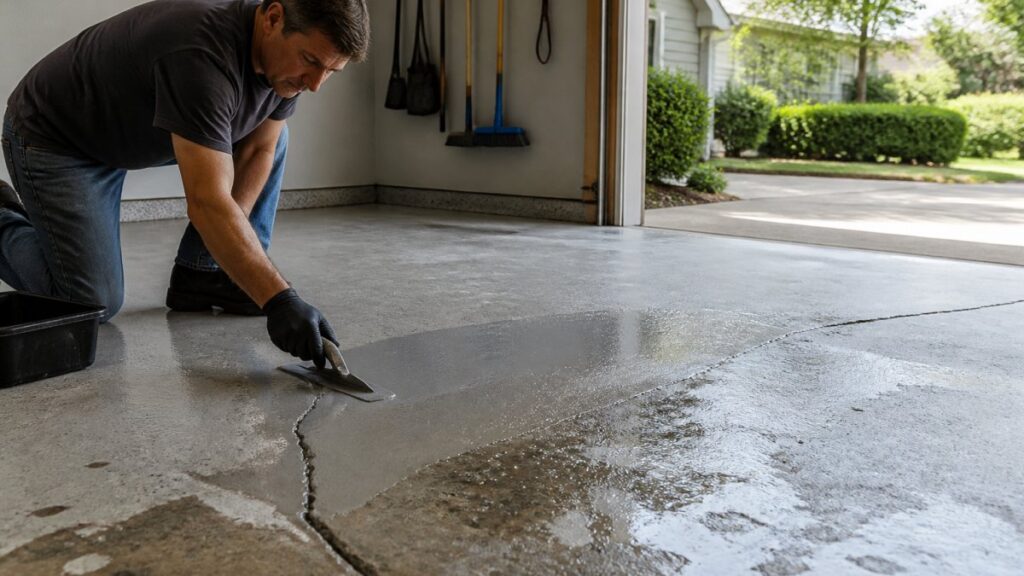
Epoxy floor repair only makes sense when the remaining coating is still bonded. Test it by pressing a putty knife under an edge.
Canada Mortgage and Housing Corporation guidance on basement and slab moisture is worth reading before you commit to any coating over old concrete.
Repair or Replace Garage Floor: A Decision Framework for Old Slabs
Most guides give you a pros-and-cons list and leave the decision to you. That is not useful when you are standing in a garage looking at a floor that is half peeled.
Start by separating coating failure from concrete failure. They look similar from standing height and they lead to opposite decisions.
Coating failure (repairable): the epoxy is lifting, peeling, chipping, or blistering, but the concrete beneath is hard, sound, and intact when you expose it. The bond failed, not the slab.
Concrete failure (not repairable with coating alone): the surface is crumbling, dusting, delaminating, or spalling; cracks are widening; there is visible efflorescence or persistent dampness.
Repair options by damage type
| Damage | Best option | What it involves | When it stops working |
|---|---|---|---|
| Small chips and scratches | Spot patch | Clean, abrade, fill with epoxy patch, blend edge | If the surrounding coating is already losing bond |
| Peeling under roughly 20% of the floor, bond sound elsewhere | Spot repair plus localized recoat | Remove loose coating, grind patches to profile, prime, recoat those areas | If moisture or movement caused the peel; it will return |
| Peeling over most of the floor | Full removal and recoat | Grind or shot-blast the entire slab, crack repair, moisture test, new system | If the slab has no vapor barrier and moisture is high |
| Hairline cracks | Crack repair before any coating | Route and fill with epoxy or polyurea patch, then coat | If cracks are moving cracks, not shrinkage cracks |
| Cracks wider than a hairline, or recurring cracks | Concrete repair first, then coating | Structural assessment, crack stitching or routing, then coating | If the cause is settlement or slab movement |
| Spalling, dusting, delamination | Full replacement of the surface | Grinding back to sound concrete, patching, possible overlay, then coating | If the damage is deep or widespread |
| Visible moisture or efflorescence | Moisture mitigation, then coating | Vapor barrier or moisture-tolerant primer system, then coating | If moisture is not addressed first |
The concrete-integrity checks that decide it
Before you price anything, do three checks on the slab itself.
- The tap test. Tap the concrete with a hammer or the handle of a screwdriver. A hollow sound over a wide area suggests a delaminated top layer. Coating will not fix that.
- The scratch test. Scratch the exposed concrete with a screwdriver. If it powders easily, the surface is weak or dusting and needs mechanical preparation before any coating.
- The crack check. Hairline shrinkage cracks are common and repairable. Cracks that are wide, offset, or reappear after filling point to slab movement, which is a concrete problem, not a coating problem.
A common pattern among contractors is that a floor which looks like an epoxy failure is really a preparation or moisture failure. That is good news for repair, because the fix is in the preparation, not the slab. It is bad news if you skip the checks and coat over a slab that cannot hold a bond.
If the concrete is sound and the damage is coating-level, repair or recoat is worth it. If the slab is crumbling, damp, or moving, no coating repair will last and the money is better spent on concrete repair or replacement first.
If you are weighing repair against a fresh start, see the flooring options we install.
How to Fix Peeling Epoxy Garage Floor Problems for Good
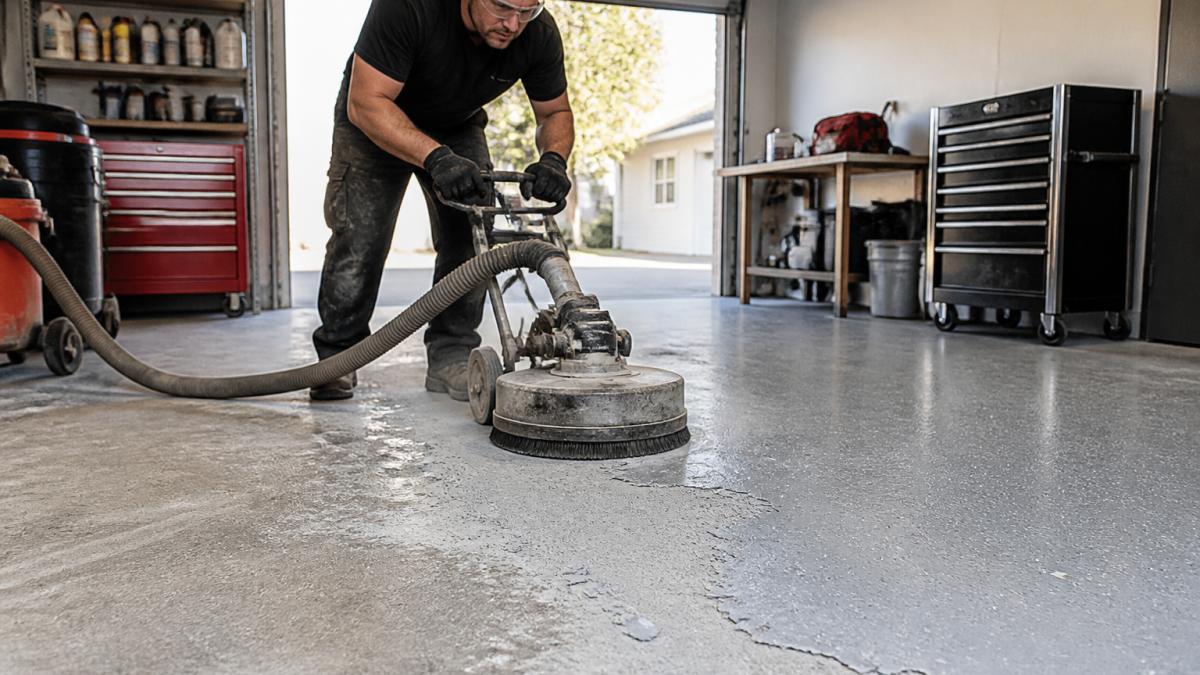
Fixing peeling epoxy means removing every square inch of coating that has lost its bond, then grinding the concrete to a profile the new coat can grip. Anything less and the peel returns.
The steps, in order:
- Test the bond across the whole floor with a putty knife and a hammer tap.
- Grind or shot-blast the entire surface, not just the damaged patches.
- Fill cracks and spalls with an epoxy patch.
- Test for moisture before any coating goes down.
- Apply a primer coat suited to the slab condition.
- Apply the base coat and broadcast aggregate while wet.
- Apply a topcoat for chemical and stain resistance.
Skipping step two is the single most common mistake. Feathering a patch into old coating looks fine for a season, then the edge lifts.
Watch out: grinding without a dust shroud and proper respiratory protection is a genuine health hazard, and many older coatings contain silica dust once sanded. For a deeper walkthrough, read our step-by-step guide to preventing epoxy cracking.
Schedule Your Private Garage Design Consultation →
Garage Floor Epoxy Cost: Repair, Recoat, or Full Replacement
Cost is where the repair-versus-replace decision gets real, and it is where most guides go quiet. The honest answer is that pricing depends on floor size, damage extent, and slab condition, so any number is a range, not a quote. But you can still compare the three paths on what drives cost and what you get for it.
What drives the price of each option
Spot repair. Spot repair generally touches the least floor area, so it is often the lowest-cost path when the rest of the coating is still bonded.
Full recoat. More expensive because every square metre must be ground or shot-blasted to profile, cracks filled, moisture tested, and a full coating system applied. This is the option most often compared to replacement, and the gap between them is usually smaller than homeowners expect because preparation dominates both.
Full replacement. Replacement can involve concrete work beyond the coating itself, such as crack repair, spall repair, or moisture mitigation, depending on the slab’s condition.
The line items that separate a cheap quote from a lasting floor
When you compare quotes, compare what is included, not just the total. A repair quote that skips grinding will fail. A replacement quote that skips moisture testing will fail too. The items that matter:
- Surface preparation method (grinding or shot-blasting versus acid etch)
- Crack and spall repair
- Moisture testing and any mitigation
- Primer suited to the slab condition
- Base coat, broadcast aggregate, and topcoat
- Vehicle downtime and cure time
A quote that is missing preparation or moisture work is not a cheaper version of the same job. It is a different, shorter-lived job.
Lifecycle logic: repair versus recoat versus replace
A spot repair buys time if the rest of the floor is sound. A full recoat resets the clock on a sound slab. A replacement resets the clock and fixes the concrete, which is the only path that makes sense when the slab itself is the problem.
The trap is comparing a repair quote to a replacement quote without checking what each includes. If the repair quote assumes the existing coating is bonded and it is not, the repair will fail and you will pay twice. If the replacement quote skips moisture mitigation and the slab is damp, the new floor will fail the same way the old one did.
Preparation and moisture work are the line items that most affect whether a floor lasts, so compare quotes on what each includes.
Pricing depends on floor size, damage extent, and slab condition, so for current pricing or a quote, visit the Lux Garages website. Tell us about your garage and we will walk you through what a proper installation involves.
Moisture Testing and Old Concrete Risks Nobody Warns You About
Moisture is the reason most old-garage epoxy fails, and it is the factor almost nobody tests for. Concrete slabs without a vapor barrier wick moisture upward year-round. A coating that traps that moisture blisters from below.
Testing moisture before coating is a useful step. A simple plastic-sheet check can show whether moisture is moving through the slab.
Old slabs bring other risks: hairline cracks that widen with freeze-thaw cycles, salt damage from winter road exposure, and previous coatings of unknown chemistry. Each one changes the preparation plan.
Schedule Your Private Garage Design Consultation
The hardest part of this decision is not the coating. It is accepting that a failing floor usually signals a slab problem, and that no coating fixes a slab.
We build garage interiors with professional-grade epoxy and polyaspartic flooring systems.
Visit the Lux Garages website to learn more about garage flooring projects.
Frequently Asked Questions
Does epoxy last on a garage floor?
Professionally installed epoxy can last many years in a residential garage. That range assumes proper surface preparation, a compatible coating system, and normal residential use. Lifespan drops sharply when the slab was not prepared correctly, when moisture is present, or when a thin hardware-store kit is applied over a contaminated surface. A floor that fails within two or three years usually points to an installation problem, not a product problem.
Can you put epoxy over old epoxy without sanding?
No. New epoxy needs a mechanically roughened surface to bond, and a glossy old coating offers nothing to grip. Without sanding or diamond grinding, the new layer sits on top and peels off in sheets within a season or two. The correct process is to grind or scarify the existing coating, remove any loose or delaminated areas, test the concrete for moisture, then apply a compatible primer and topcoat. Skipping the prep is the single most common reason recoats fail.
Is it better to repair or replace an old garage floor?
It depends on the damage pattern and the slab underneath. If the concrete is sound and the failure is isolated to peeling or chipping areas, a targeted epoxy floor repair is usually the better value. If the slab has widespread cracking, spalling, or moisture pushing up through the concrete, a full replacement with a proper coating system makes more sense. The decision framework comes down to substrate condition, damage severity, and how long you plan to stay in the home.
How long does a repaired epoxy garage floor last?
A properly repaired floor that addresses the root cause can last a long time. A cosmetic patch that covers damage without fixing the cause, such as moisture or poor adhesion, may fail again within a year or two. Repair durability depends on how much of the old coating is removed, whether the concrete is tested for moisture, and whether a compatible primer and topcoat are used.
When should an old garage floor be replaced instead of repaired?
Replace when the concrete itself is failing, not just the coating. Signs include widespread cracking, spalling or crumbling at the surface, a hollow sound when tapped, standing moisture, or multiple failed repair attempts in the same area. A professional assessment with moisture testing will confirm whether the slab can support a new coating system.
A peeling floor is a question, not a verdict. If you are standing in your garage wondering whether to patch it or start over, start your project and we will help you read the slab before you spend a dollar on coating.
