
Soundproofing a Garage Workshop: What Actually Works
Last Updated: November 4, 2026
Quick Summary
Soundproofing a garage workshop works by targeting isolation first: seal every gap and crack with acoustic sealant, weatherstrip the garage door, and isolate machine vibration from the structure. Absorption products like foam panels only control echo inside the room and do almost nothing to stop noise reaching the house.
- Air sealing is the cheapest, highest-return step and should always come first.
- The garage door is usually the largest and weakest acoustic element in the room.
- Mass stops airborne sound and decoupling stops structure-borne sound; you need both.
- Set table saws and jointers on isolation pads or spring mounts rated for their weight.
- Spend down the priority list until the noise is acceptable.
Table of Contents
- Why a Garage Workshop Leaks Sound (and What Actually Stops It)
- Sealing Gaps and Cracks Before Anything Else
- Garage Door Acoustic Sealing That Makes a Measurable Difference
- The Best Soundproofing Materials for Workshops
- Adding Mass and Decoupling Walls and Ceilings
- Quieting the Machines: Vibration Isolation and Dust Control
- The Cost of Soundproofing a Garage and How to Prioritize It
- Planning Your Garage Workshop Build with Lux Garages
- Frequently Asked Questions
Why a Garage Workshop Leaks Sound (and What Actually Stops It)
Soundproofing a garage workshop often fails because people treat it as a shopping problem when it is a physics problem. Sound escapes through airborne paths like gaps and thin walls, and structure-borne paths like a saw vibrating through the slab into the house frame.
A common pattern is that a homeowner adds foam panels, the echo improves, and the noise in the kitchen barely changes.
Sound Isolation vs. Sound Absorption: Two Different Jobs
Sound isolation is the reduction of sound transmission between the garage and the rest of the house. Sound absorption is the reduction of reflected sound energy inside the room.
Absorption controls echo. Isolation controls what your family hears through the wall. Foam panels, carpets, and sound-insulated curtains are absorption products.
Everything here targets isolation first, since that is the complaint that sends people looking for answers. Absorption is a later comfort upgrade.
Sealing Gaps and Cracks Before Anything Else
Air sealing is the cheapest, highest-return step and should always come first. Sound travels through air, so every gap is a leak path, and a garage typically has more than any other room.
Walk the perimeter with a caulking gun and work through this list:
- The gap under and around the man door, including the threshold
- Electrical outlets and switches on shared walls, which need acoustic putty pads behind the plates
- Pipe and conduit penetrations through the wall or ceiling
Use acoustic sealant rather than standard caulk at framing joints; it stays flexible as the structure moves. Watch out: sealing a garage tightly can trap carbon monoxide and dust, so never block combustion air for a gas heater or water heater.
Garage Door Acoustic Sealing That Makes a Measurable Difference
The garage door is usually the largest and weakest acoustic element in the room, and garage door acoustic sealing delivers more improvement per dollar than almost any other single fix. A standard sectional door is thin steel with perimeter and inter-panel gaps that behave like open windows.
Three changes matter most, and each one addresses a different path:
- Perimeter weatherstripping. Replace worn vinyl with a compression seal that fully contacts the floor and jambs when closed. A bulb seal on the jambs and a threshold seal at the floor close the largest continuous gap; the seal must compress, not just touch.
- Panel hinges and seams. Flexible seals at each hinge line close gaps that open as the door articulates. Small individually, they add up to a significant linear opening across a wide door.
- Door mass. A door insulation kit or rigid foam core bonded to the panels adds weight and cuts transmission. Most kits underdeliver: thin foil-faced foam improves thermal performance far more than acoustic performance, because isolation depends on mass per unit area, not trapped air alone.
Sectional vs. Roll-Up Doors
A sectional door has four or five panels with hinge lines and a track that penetrates the wall; sealing both matters. A roll-up door coils into a drum above the opening, and its curtain is typically a single thin sheet with a larger perimeter gap and less forgiving seal geometry. If you have one, prioritize the perimeter seal and consider a separate acoustic curtain or vestibule.
Insulation Kits and Their Limits
A door insulation kit is worth installing, but be realistic. It reduces radiated noise from the panels, improves comfort, and can take the edge off mid- and high-frequency noise, but it does not turn a lightweight door into a barrier. The steel skins remain thin, the perimeter gaps remain, and low-frequency noise from a table saw or dust collector passes through mass-limited assemblies almost unchanged.
Balance, Operation, and Opener Noise
Adding mass to a door changes its balance.
Opener noise is a separate path. A chain-drive opener transmits vibration into the ceiling structure above the garage, which is often continuous with the house frame.
Watch out: never disable or bypass the door’s safety reverse mechanism while working on seals or balance, and do not block the photo-eye or the bottom safety edge with added weatherstripping.
The Best Soundproofing Materials for Workshops
Dense, limp, and continuous materials such as mineral wool, mass-loaded vinyl, and layered drywall are commonly used for workshop soundproofing.
Mineral Wool, Foam Board, and Mass-Loaded Vinyl Compared
| Material | Primary job | Best use in a workshop | Limitation |
|---|---|---|---|
| Mineral wool | Absorbs sound in the cavity | Filling stud and joist bays | Needs airtight assembly to perform |
| Open-cell spray foam | Air sealing plus absorption | Irregular framing, rim joists | Lower density than closed-cell |
| Foam board | Thermal break, decoupling | Under drywall, behind furring | Poor barrier on its own |
| Mass-loaded vinyl | Adds limp mass | Wrapping ducts, layering walls | Heavy, and expensive per square metre |
| Drywall, double layer | Adds mass | Walls and ceilings | Needs decoupling to work well |
A common mistake is treating any one of these as a complete solution. Mineral wool in an unsealed wall still lets air through. Mass-loaded vinyl on a rigidly connected wall still transmits vibration.
Adding Mass and Decoupling Walls and Ceilings
Mass stops airborne sound; decoupling stops structure-borne sound. You need both, and this is where most garage workshop soundproofing projects succeed or stall.
The sequence we use is straightforward:
Schedule Your Private Garage Design Consultation →
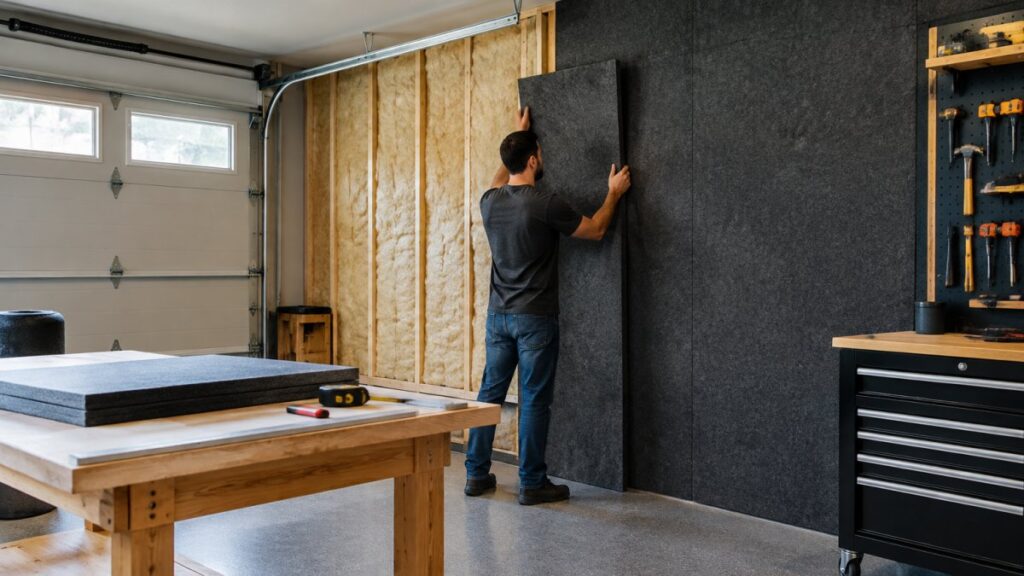
- Fill the stud and joist bays with mineral wool, densely and without compression.
- Install resilient channels perpendicular to the framing to decouple the finish layer.
- Hang a first layer of drywall, then a second layer with seams offset from the first.
- Seal every seam and penetration with acoustic sealant.
- Apply a damping compound between layers where a higher specification is needed.
For serious isolation, the room-within-a-room approach builds a separate stud frame that touches the existing structure nowhere except the floor. If you are choosing a wall finish at the same time, our guide to choosing the best garage wall finish for a home workshop covers how surface choice interacts with acoustic layers.
Quieting the Machines: Vibration Isolation and Dust Control
Vibration is the noise path most homeowners overlook. A planer or table saw bolted to a bench transmits energy directly into the slab, which is connected to the house frame.
Start with the source, not the room. The goal is to break the rigid connection between the machine and the structure, and to reduce the noise the machine radiates into the room air.
Machine-by-Machine Isolation
Different tools produce different noise profiles, and the fix should match the profile:
- Table saws and jointers. These produce motor noise, blade noise, and structure-borne vibration through the cabinet and feet. Set the machine on an isolation pad or spring mount rated for its weight, and replace rigid feet with rubber or cork composite feet. A mobile base with hard wheels defeats the purpose; choose rubber-tired casters or lift the machine off the base when running.
- Planers. The cutterhead and feed rollers generate strong low-frequency vibration. Isolation mounts help, but the sheet-metal cover often radiates noise; a damping layer or mass-loaded vinyl wrap on the cover can reduce radiated noise noticeably.
- Dust collectors and shop vacuums. Often the loudest continuous source, dominated by motor and impeller noise. Locating the collector outside the workshop or in a ventilated cabinet removes that noise at the source. A shop vacuum can go in a ventilated closet or under a bench with a baffled air path; the enclosure must allow airflow or the motor will overheat.
Source-Level Enclosures
An enclosure around a noisy machine is the most effective single fix when built correctly. The principles match the room: mass, sealing, and decoupling. Build it from dense sheet material with an absorptive lining, seal the seams, and mount it so it does not touch the machine rigidly. Provide ventilation sized for the motor’s cooling needs, and route the air path through a baffle so noise does not escape straight out of the vent.
Dust Collection as an Acoustic System
Dust collection is part of the acoustic conversation because the collector and ductwork both carry noise and vibration. Keep hose runs short and flexible, since rigid ductwork carries vibration and can act as a speaking tube between the collector and the room.
Fire safety belongs here too. Any enclosure around a motor or dust collector needs to be built from non-combustible materials, and dust collection ductwork should be bonded and grounded.
Measuring Before and After
You cannot manage what you do not measure. Use a sound level meter or phone app and take readings at a consistent location in the room that receives the noise, such as a bedroom or kitchen, with the machine running under load.
Heavy machines and isolation work also raise floor-loading questions, which is why we point clients to what a garage workshop floor can hold before anything gets bolted down.
The Cost of Soundproofing a Garage and How to Prioritize It
The cost of soundproofing a garage depends almost entirely on how far you go. Air sealing and door weatherstripping are modest material costs and weekend labor. Insulation and a double-layer drywall assembly with resilient channels sit in the middle.
Because every project is different, costs are best confirmed through a direct quote for your garage. What we can give you is a priority order that delivers the most reduction per dollar:
| Priority | Work | Relative cost | Impact on noise transfer |
|---|---|---|---|
| 1 | Seal gaps, cracks, and penetrations | Low | High |
| 2 | Weatherstrip and seal the garage door | Low to moderate | High |
| 3 | Isolate machine vibration | Low | Moderate to high |
| 4 | Mineral wool plus resilient channel and double drywall | Moderate to high | High |
| 5 | Room within a room, upgraded door | High | Highest |
Spend down that list until the noise is acceptable. For full renovation budget context, including how acoustic work fits alongside flooring and cabinetry, see our garage renovation cost guide.
Planning Your Garage Workshop Build with Lux Garages
A workshop that is quiet, dust-controlled, and comfortable is a design problem before it is a construction problem.
Lux Garages designs and builds complete garage interiors, including building envelope work, electrical, and plumbing.
If you are ready to plan the whole space, our complete guide to garage showroom and workshop design walks through how the two functions coexist. When you want to move from planning to a real scope and timeline, start your project and tell us about your garage, its approximate dimensions, and what you would like to change.
The hardest part of soundproofing a garage workshop is not the materials, it is knowing which noise path to attack first and how much isolation your house actually needs.
Frequently Asked Questions
What is the most effective way to soundproof a garage workshop?
Seal every gap first, then add mass. Air leaks around the garage door, windows, and penetrations let more noise escape than most people expect, so weatherstripping and acoustic sealant come before insulation. After that, mineral wool in the wall cavities and a second layer of drywall raise the wall mass and cut sound transmission. Decoupling with resilient channels helps further if you are framing new walls. Treat absorption panels as the last step, since they reduce echo inside the shop but do little to stop noise leaving it.
Can you soundproof a garage without major renovations?
Yes, up to a point. Sealing gaps, installing a proper garage door acoustic sealing kit, hanging sound-insulated curtains, and putting machinery on vibration isolation pads all work without opening walls. These steps target the weakest paths first and often deliver the most noticeable reduction per dollar. What they cannot do is add wall mass or decoupling, so very loud tools will still transmit through the structure. If the shop shares a wall with living space, plan for insulation and an extra drywall layer eventually.
How much does it cost to soundproof a garage workshop in Canada?
The cost of soundproofing a garage depends on how far you go. DIY sealing materials and weatherstripping are the cheapest tier, mineral wool and drywall sit in the middle, and full decoupling with resilient channels plus double drywall is the most expensive. Material prices vary by supplier and region, so get current quotes rather than relying on older figures. Prioritize sealing and the garage door first, since those deliver the largest noise reduction for the smallest spend.
Do soundproofing panels actually work for power tools?
Acoustic panels absorb sound inside the room, which makes the workshop quieter to stand in and reduces echo. They do not block sound from leaving, because they add almost no mass and seal nothing. For power tools, the effective sequence is sealing air gaps, adding mass to walls and ceilings, and isolating vibration at the machine. Panels are a good final layer for comfort and recording clarity, but on their own they will not stop a table saw from bothering the neighbors.
